Showing posts with label Mobile. Show all posts

Wednesday, January 1, 2014

Is it being digital or being customer focused?


Recently David Cooperstein from Forrester Research has invested a fair amount of time with CMOs and agency executives, working through the challenges that marketing faces, especially as shiny new objects like social and mobile develop some patina and digital gets categorized as a mature channel. In a past post on Forbes he called the era we now live in a “post-digital” world for marketers, because the strategies that matter most are those that don’t start with the channel (i.e. mobile-first or digital-first). Marketers need to put themselves in their customers’ seat and define the marketing activities they take on from a customer-first perspective.


I agree that it is important to focus on the customer first. That is to some extent all that matters. 

Read more in this blog:  The Age Of The Customer Requires An Obsessive Focus By CIOs And CMOs | Forrester Research

Monday, July 22, 2013

Mobile (Digital) Wallets are gaining traction

A digital wallet refers to an electronic device that allows an individual to make electronic commerce transactions. This can include purchasing items on-line with a computer or using a smartphone to purchase something at a store. Increasingly, digital wallets are being made not just for basic financial transactions but to also authenticate the holder's credentials. For example, a digital-wallet could potentially verify the age of the buyer to the store while purchasing alcohol. It is useful to approach the term "digital wallet" not as a singular technology but as three major parts: the system (the electronic infrastructure) and the application (the software that operates on top) and the device (the individual portion).

An individual’s bank account can also be linked to the digital wallet. They might also have their driver’s license, health card, loyalty card(s) and other ID documents stored on the phone. The credentials can be passed to a merchant’s terminal wirelessly via near field communication (NFC). Certain sources are speculating that these smartphone “digital wallets” will eventually replace physical wallets. The system has already gained popularity in Japan, where digital wallets are known as Osaifu-Keitai or “wallet mobiles”

The potential of mobile payments is enormous: there are 1.3 billion active credit and debit accounts in the world, but more than 5 billion active mobile phone accounts. In Africa and Asia, financial transactions via mobile phone are a widespread way to overcome deficits in banking infrastructure.

In the western world, the growing adoption of smartphones and the technological progress have given rise to the idea of mobile wallets.

This chart shows key facts about mobile wallets: adoption, benefits and opportunities.


Saturday, July 20, 2013

Technology won’t save you


Will technology save you? Not likely. It can help transform you but without a passion for amazing experiences that customers enjoy, find simple to navigate and meet their needs, no amount of technology will help. It starts with a well thought out strategy. It moves to people who committed to great experiences. It involves processes that support the designed experience. And it involves the right technology. But it doesn’t, under any circumstances, start with technology.

It is a myth that this is about technology. Everyone thinks that technology is changing behavior. The opposite is true. Our behavior is using technology. For example, the inclination to share is nothing new. We have been sharing our experiences before technology could enable it. All technology is doing is speeding it and enabling it on connected devices.

Are you betting that social media and mobile devices are the new channels for engagement? What data do you have to support that? You may have some and that is great. You may not and that is dangerous. What role does Facebook play in improving the experience for your major customers? What ROI are you getting out of Twitter?

Trust me, I believe in the strategic use of technology. I’m not a fan of blind faith. Hope is not a strategy. Soft or non-existent metrics aren’t useful. You can measure most if not all of your customer experience initiatives.

What is needed for transformation is a path that begins with discovery and completely rethinking the new customer journey. It is intentional and it is cost effective. To get somewhere, we need some discipline to test and prove that it works. We also need to have courage to find out it doesn’t. We can’t get paralyzed because we don’t know if it will work or not. Avoid the temptation to pilot something and have the courage to embark on a small test.

If you have seen the TV show Dragnet, you remember Jack Webb making famous the line “Just the facts”. That should be our internal mantra. The truth is that results can and should be quantified. Someone advocating the flavor of the month with no tests and results needs to be challenged. It is generally a question of who will have the courage to do it. A spirit of discovery will lead you to know where you are losing customers and where you are gaining them. Donations are constantly being earned and lost. Some that is happening through new channels and touch points. A willingness to test and discover is your friend. Blindly following what hasn’t been tested is your enemy.

A great starting point is to always walk on the same path you think your customers are or should be. What is the experience you have? Is it the same one you want for your customers?

Saturday, July 13, 2013

How the remote workforce is changing

We all know it is true. We see it happening every day. The remote workforce is growing, it is mainstream, it is maturing and it is learning new skills. And, it won't go back to the way it was. We have an anytime, anywhere revolution going on.

For the Digital Executive, this is a huge opportunity with a lot of upside. You can now live in a world with the best talent regardless of where your business is located. Is the best talent for the job in Topeka? You can hire them. Think of the "Anywhere Employee". 
As advances in technology have made it a practical possibility for millions, remote working has increased dramatically over the last decade.

While once working from home was considered a bit of a novelty, we argue that it is now so mainstream it’s more interesting to consider how the remote workforce is changing.

Mashable spoke to human resources professionals and other experts to get some interesting insight on this subject.

How the Remote Workforce Is Changing

Thursday, July 11, 2013

Mobile internet browsing takes off

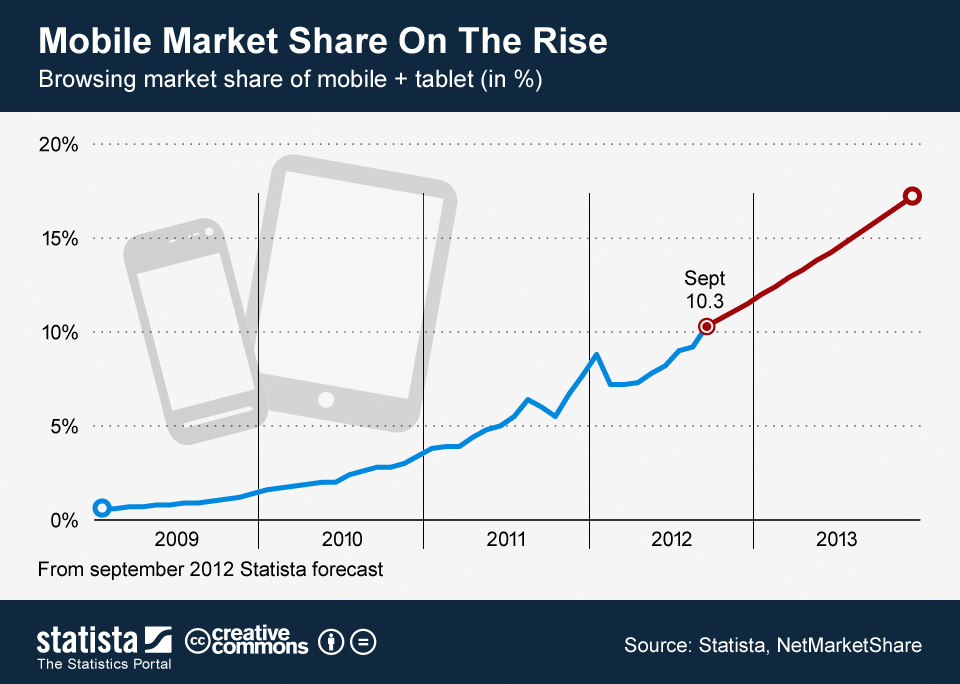
Mobile internet browsing continues to take off. It certainly highlights the need to make sure everything is mobile ready. This is a trend that will continue rise sharply.

As of September 2012, mobile phones and tablets for the first time was responsible for ten percent of internet browsing. The data is from web analytics provider NetMarketShare. By the end of 2013, the share of mobile end devices will increase to over 17 percent.

For the digital executive, it is important to evaluate your entire web experience from the point of view of mobile devices. Start testing your own sites to see what the experience is like. Investing in experience improvements now will get you ahead of the curve while you can still be relevant. 


Thursday, April 25, 2013

What is your mobile strategy?

According to Latha Maripuri, Director of IBM Mobile and Security Services, mobile technology has unquestionably changed how we interact in both our business and personal lives. In fact, mobile devices have quickly moved from a nice-to-have technology to a necessity for most of us.

But the integration of mobile within our lives doesn’t stop there. We’re using mobile technology in innovative ways and countless places across every industry. For example, doctors can track therapeutic effectiveness through remote monitoring apps, keeping them updated on patients even when neither is in the hospital. The examples are endless.

More here: Mapping Out the Top 4 Strategies for the Mobile Enterprise « A Smarter Planet Blog.

Tuesday, April 16, 2013

Your desk job makes you fat, sick and dead ...

Podio co-founder Jon Froda along with panelists Cali Williams Yost, CEO and Founder of Work+Life Fit Inc, Kate Lister from Telework Research & Richard Leyland, Founder of Worksnug explored the potential of ‘workshifting‘ and how working from anywhere has immense possibilities when it comes to productivity & work-life balance.

[slideshare id=17140312&style=border:1px solid #CCC;border-width:1px 1px 0;margin-bottom:5px&sc=no]

Are there risks to mobile CRM?

There's no stopping the mobile CRM revolution, but those who rush into it headlong with an eye only to the many benefits may be in for an unpleasant shock. As if we didn't have enough to worry about, mobile CRM is laden with risks, too -- from getting on the wrong side of the customer to getting on the wrong side of the federal government. Then there are the myriad security concerns that go along with making sensitive company data accessible on a device that may be woefully insecure.

More here: The Hidden Risks of Mobile CRM, Part 1 | Mobile CRM | CRM Buyer.

Monday, April 15, 2013

What is the difference between responsive vs. adaptive web design?

Users who access your websites through their mobile devices or other display screens really do not care what method you use, just as long as that they can effectively navigate your website on whatever device they happen to be using.

For that reason, the two methods described in this article have been devised for web developers to meet the challenge, and while responsive (RWD) and adaptive (AWD) design methods are both addressing the issue for rendering websites on mobile devices, there are subtle differences between them that it helps to be aware of.

More here: What is the difference between responsive vs. adaptive web design? | TechRepublic.

Monday, April 1, 2013

Is it productive to work at home or anywhere other than the office?

Certain subjects just naturally incite opinion wars. The big ones, like political preferences, or whether you’re Team A or Team B, are better left out of polite conversation. But when it comes to doing your job effectively, where do we draw the line? Should the nature of a person’s autonomy — or lack thereof — be at the whim of the boss, or the discernment of the employee?

The four corners of the Internet nearly came to blows recently when tech-world darling and Yahoo CEO Marissa Mayer boldly put a stop to employees working remotely. Needless to say, people are a little upset.

I'm definitely in the let them work at home camp. Here is a pretty good infographic on the state of things.

Working from home infographic

Thursday, March 28, 2013

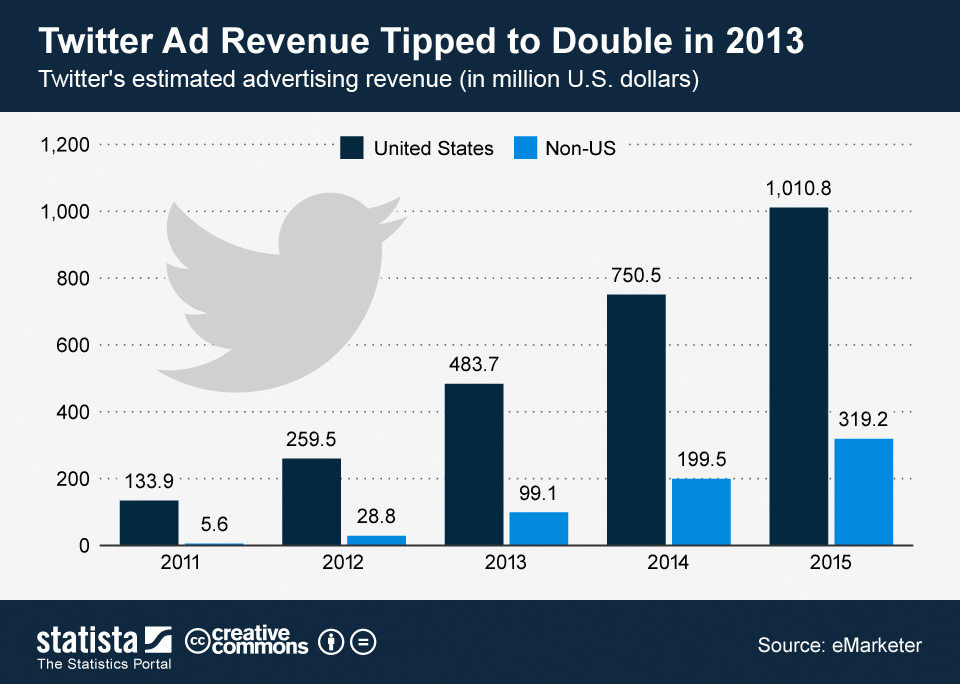
Twitter is set to grow it's income

Twitter is making some good progress. Much of this is coming from the mobile ad world.

Twitter Ad Revenue

Wednesday, March 27, 2013

Connected devices in 2014

Interesting take on where the mobile world is heading. Seems pretty clear.

Connected Devices 2014

Thursday, February 14, 2013

Best of Tom Peters Cool Friends -- Sally Helgesen

Tom Peters has some very cool friends. He is also very kind to introduce us to them. I haven't read much from Sally Helgesen yet but she is going on my list. I am particularly intrigued by "The Web of Inclusion".
With three interviews to her credit, Sally Helgesen is not only one of our favorite Cool Friends, she's tied for first place in frequency of Cool Friends solo interviews (with the prolific Seth Godin!). She also has a section of Tom's Mother of All Presentations devoted to her work. Best known for her 1990 classic, The Female Advantage, Sally has a focus on women's work issues, but her insights are universal—perhaps essential for all who would succeed at work in the 21st Century.

Interview No.1, posted 2000. Book under discussion: The Web of Inclusion: A New Architecture for Building Great Organizations.

Interview No.2, posted 2002, and the book: Thriving in 24/7: Six Strategies for Taming the New World of Work.

Interview No.3, posted 2010, and the book featured (coauthored with Julie Johnson): The Female Vision: Women's Real Power at Work.

We'd suggest you read all three interviews and maybe pick up a couple of Sally's books, too!

via Best of the Cool FriendsSally Helgesen | tompeters!.

Thursday, January 31, 2013

Samsung outsells Apple in 2012

Samsung capped an impressive year 2012 with record smartphone sales in the fourth quarter. The Korean company shipped 63.7 million smartphones during the holiday quarter, outselling its biggest rival Apple by more than 15 million units.

Samsung’s strong line-up of high-end and low-cost smartphones has helped the company to increase shipments by 76 percent over last year’s fourth quarter.


Apple sold 47.8 million smartphones, cementing its status as the second largest vendor. With an increase of 29 percent, the Cupertino-based company saw the lowest relative growth among the top 5 vendors though, a testament to the stronger competition from company’s such as Sony, Huawei and ZTE. The latter two, both Chinese manufacturers, entered the top 5 as the Chinese smartphone market continued to grow rapidly.


Overall, smartphone demand remains strong as overall shipments in the fourth quarter rose 36 percent to a total of 219 million units.

2013_01_29_Shipments


http://www.statista.com/topics/840/smartphones/chart/852/global-smartphone-shipments-in-q4-2012/

Saturday, January 19, 2013

The power of mobile

It is hard to imagine a world without mobile computing. It’s funny to think back to when getting excited about technology was considered nerdy. These days, almost everyone is keen on the latest in devices particularly those of the mobile variety. Problem is, now that we’ve got the digital world in our pockets, we’d like to keep it there. This makes things a little sticky for reluctant business leaders, as the consumerization of the enterprise continues to hit them on all sides.

Power of Mobile Infographic


Thursday, December 6, 2012

iPad eclipses iPhone launch

When Apple introduced the original iPad in January 2010, many analysts were sceptical whether the new device could replicate the iPhone’s success in establishing a new product category. Two and a half years and 100 million shipped iPads later, the answer has to be: yes!

Not only has the iPad redefined (or reignited) the tablet market, it even eclipsed the iPhone in terms of launch sales. In the first ten quarters after the iPad’s launch in April 2010, Apple shipped 98.16 million units of its popular tablet. During the same period after the iPhone’s launch in 2007, Apple shipped 33.75 million units of its popular smartphone. I.e. the iPad outsold the iPhone 3 to 1 in its first two and a half years on the market, making it one of the fastest consumer electronics launches ever. 

The recently launched iPad Mini could give iPad sales another boost, as the entry price to Apple’s tablet products dropped from $399 to $329.  This chart shows cumulative global unit shipments in the first 10 quarters after the launches of Apple's mobile gadgets: the iPod, the iPhone and the iPad.

Apple iPad growth

http://www.statista.com/topics/847/apple/chart/753/apple-s-mobile-product-launches/

Friday, November 30, 2012

Which mobile platform should you pick? Android, iOS, Windows 8 or HTML5?

The last month has introduced much new food for thought if you are trying to decide which mobile platform to build on first:

Thirty days ago, you were probably thinking to start with iOS, not just because of the launch of the iPad Mini but also the preponderance of Apps in iTunes

Then Microsoft launched Windows 8 (and the Surface), driving a full-court press to get developers to build apps for the Windows Store

A few days later, IDC came out with the latest numbers, showing Android was crushing everyone, with a 75% market share of new phones sold in Q3.

As a result, some declared that iOS was going the way of the Dodo–until last week, when iOS (especially the iPad) crushed the competition in online purposes purchases on Black Friday.

It has definitely been an eventful pre-Holiday Season in mobile.

With all these different metrics and shifts in leadership, which platform do you pick? The market share leader (Android)? The eCommerce leader (iOS)? The one most familiar to enterprise (Windows)? The one most open of all (HTML5)?

If you are Fortune-500 company with a big mobile budget the decision is easy: build on several. If you are smaller, you probably can only build one or two at most (or at least one to start on first). Which one do pick?

Question 1: What is the (Intended) Usage Pattern of Your Customers?


Question 2: If You ARE Building an App, What Are Your Customer Demographics?

Tuesday, November 20, 2012

Is your eCommerce mobile?

As we are approaching the most important days of this year’s holiday shopping season, many experts are predicting that mobile devices will play a bigger role than ever in the hunt for Christmas gifts.

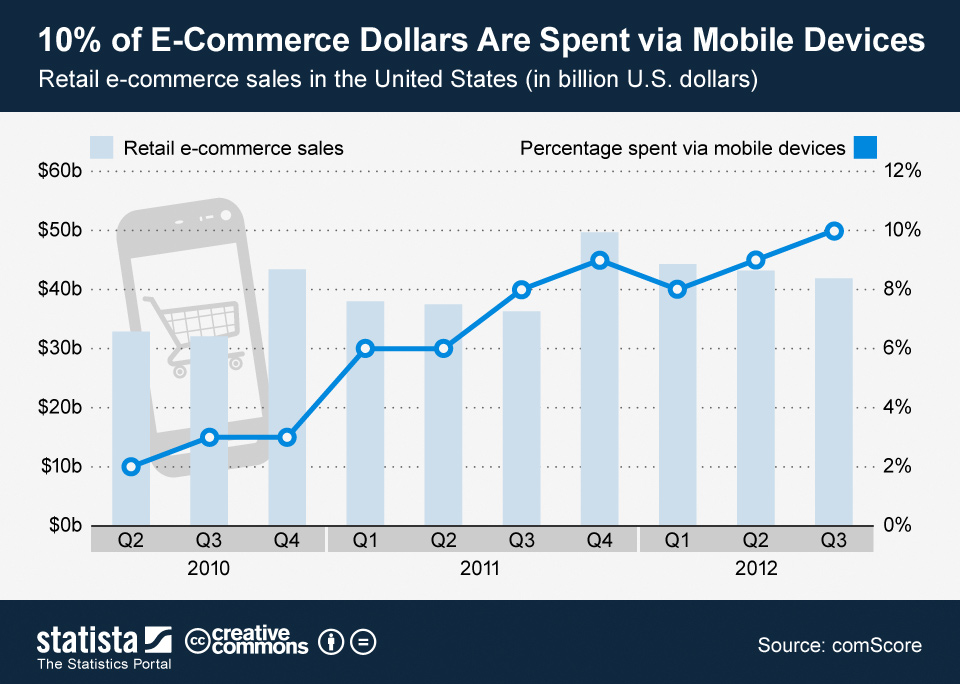
Consumers are using their smart devices to research products, check prices and more and more often to actually make a purchase. According to comScore data, 1 in 10 e-commerce dollars spent in the third quarter was spent via smartphone, tablet or another mobile device.

With ever-growing adoption of smartphones and the huge popularity of tablets, it can be safely assumed that the percentage of mobile purchases will grow further in the future and retailers are well-advised to embrace their mobile audience.

This  chart shows quarterly retail e-commerce sales in the United States and the percentage of sales made through mobile devices.


http://www.statista.com/topics/871/online-shopping/chart/726/e-commerce-sales-in-the-united-states/


Wednesday, November 14, 2012

Small Business Strategy: 10 Trends to Watch to stay on the disruptive edge

There is no doubt technology is disrupting the traditional business models. Customers are in charge and they are plugged in. No one of these may be right for you but you should be spending time researching which are the right ones and leveraging them. You can either disrupt or be disrupted.


Image representing Brian Solis as depicted in ...


So here is a good list to start with via Small Business Strategy: 10 Trends to Watch - Brian Solis..

 
1. Social Networks from Facebook to Twitter to Google+ and how they’re connecting to influencers and businesses (note: pay attention to nicheworks as well such as Path and Instagram.)

2. Geolocation check-in services such as Foursquare and Facebook location updates to share locations and earn rewards or opportunities for discounts

3. Crowdsourced discounts and deals including Groupon and LivingSocial and what’s valued and why

4. Social commerce services like Shopkick and Armadealo and how they create personalized experiences that are worth sharing

5. Referral based solutions like Yelp, Service Magic (now HomeAdvisor), and Angie’s List to make informed decisions and how shared experiences can improve your business, products, and services

6. Gamification platforms such as Badgeville and Fangager, and why rewarding engagement improves commerce and loyalty

7. How your consumers using mobile devices today and what apps they’re installing. Also, how they’re comparing options, reviewing experiences and making decisions while mobile?

8. The online presence your business produces across a variety of platforms such as tablets, smartphones, laptops and desktops. You must realize how consumers are experiencing the online presences you create and whether or not they deliver a holistic and optimized experience for each platform.

9. The consumer clickpath based on the platform consumers are using. Are you steering experiences based on the expectations of your customers? And are you taking into consideration the device or network where the clickpath begins and ends? Are you integrating Facebook F-commerce and m-commerce into the journey?

10. The expectations of connected consumers, what they value in each channel and platform, where they engage and how your business can improve experiences and make them worthy of sharing.


Wednesday, November 7, 2012

Tablets are the fastest adopted device in history

English: The iPad on a table in the Apple case

The use and adoption of tablets is exploding. Some just use it to access email on the run, others are using to easily show presentations to clients and customers and some are just having fun.

Tablets are the fastest-adopted devices in history. If we mark the modern tablet era by Apple's 2010 iPad launch, then an astounding 84 million iPads and as many as 120 million tablets in total have flown off the shelves in just two years. Forrester's global workforce and decision-maker surveys and client conversations show just how fast tablets are being adopted. What is your take on all this? As an iWorker, how are you using tablets?


  • Three-quarters of a billion tablets will be in use by 2016. It took more than 20 years for the PC to reach an installed base of 750 million people. But tablets will surpass that mark in less than half the time. Global tablet sales will top 375 million in 2016 with about one-third of tablets acquired by businesses for employees. Back in 2007, we wrote that to reach the second billion users, the computer market would be driven by lower-cost hardware, useful applications, and easy access to the Internet from anywhere.Tablets fit that bill perfectly.

  • Some 81% of firms expect to support tablets for employees. IT decision-makers are getting tablet fever as 81% of firms report interest in using tablets. According to these IT decision-makers, tablets will come into the enterprise via several doors, including employees bringing their own: Our latest survey of global information workers shows that 12% use tablets, and 8% paid for it themselves. And more than half of the 1,004 firms we surveyed plan to increase their spending on mobile devices and apps by at least 10% next year.

  • Tablets will accelerate the rise of the anytime, anywhere information worker. Today, 15% of information workers use at least three connected devices for work, work from at least three different locations, and use at least seven apps for work. And 30% of information workers satisfy at least two of those three criteria. The rise of tablets will drive the number of anytime, anywhere information workers up. Tablets enable access from more locations and bring relevant and useful apps to make employees more productive.


via Forrester Research : Research : Mastering The Business Tablet Landscape.