Showing posts with label Twitter. Show all posts

Saturday, January 11, 2014

Can one simple oversight bring our stock price down 8% in two weeks?

It is easy to underestimate the new power that consumers have in the digital world. Don't let it happen to you. Will it take a disaster to get our attention. Let us hope it isn't so. Now is the time to obsess about how our customers may point out our vulnerabilities.
Almost five years ago, I was sitting in the conference room of one of the world’s largest insurance companies, trying to push the idea of social customer relationship management to their corporate marketing team. I showed them the power of Twitter and Facebook, and painted pictures of how they could get closer than ever to their customers with these then-new touchpoints. Roughly 4 hours and 45 slides later, the CMO stood up, shook my hand, and told me how he realized going social and “being there” for his customers was important. And then he added that he just didn’t have the bandwidth for it. He explained why his company was just not ready to go social, and why he believed it would be far too risky to allow his customer service onto public forums or leave his brand open for user generated debate. About six months later, a tweet from an angry customer went viral and brought the insurance giant’s stock prices down by 8%. In a mere two weeks!
Read more: The Customer Support Hierarchy of Needs - Vikram Bhaskaran - Harvard Business Review
Enhanced by Zemanta

Saturday, July 20, 2013

Technology won’t save you


Will technology save you? Not likely. It can help transform you but without a passion for amazing experiences that customers enjoy, find simple to navigate and meet their needs, no amount of technology will help. It starts with a well thought out strategy. It moves to people who committed to great experiences. It involves processes that support the designed experience. And it involves the right technology. But it doesn’t, under any circumstances, start with technology.

It is a myth that this is about technology. Everyone thinks that technology is changing behavior. The opposite is true. Our behavior is using technology. For example, the inclination to share is nothing new. We have been sharing our experiences before technology could enable it. All technology is doing is speeding it and enabling it on connected devices.

Are you betting that social media and mobile devices are the new channels for engagement? What data do you have to support that? You may have some and that is great. You may not and that is dangerous. What role does Facebook play in improving the experience for your major customers? What ROI are you getting out of Twitter?

Trust me, I believe in the strategic use of technology. I’m not a fan of blind faith. Hope is not a strategy. Soft or non-existent metrics aren’t useful. You can measure most if not all of your customer experience initiatives.

What is needed for transformation is a path that begins with discovery and completely rethinking the new customer journey. It is intentional and it is cost effective. To get somewhere, we need some discipline to test and prove that it works. We also need to have courage to find out it doesn’t. We can’t get paralyzed because we don’t know if it will work or not. Avoid the temptation to pilot something and have the courage to embark on a small test.

If you have seen the TV show Dragnet, you remember Jack Webb making famous the line “Just the facts”. That should be our internal mantra. The truth is that results can and should be quantified. Someone advocating the flavor of the month with no tests and results needs to be challenged. It is generally a question of who will have the courage to do it. A spirit of discovery will lead you to know where you are losing customers and where you are gaining them. Donations are constantly being earned and lost. Some that is happening through new channels and touch points. A willingness to test and discover is your friend. Blindly following what hasn’t been tested is your enemy.

A great starting point is to always walk on the same path you think your customers are or should be. What is the experience you have? Is it the same one you want for your customers?

Saturday, May 11, 2013

You're Doing Social Wrong. Your Teenager Does It Right.

It seems that everyone is freaking out about teens abandoning social media sites like Facebook. By "everyone" I mean advertisers. They’re racking their brains trying to figure out why it’s happening. If you’re puzzled too, read this lovely piece in Medium by Cliff Watson, who argues that the number one reason kids don't need Facebook is that they "literally don't need Facebook."


After running through a host of theories as to why, including the fact that parents (ew) and even grandparents are on Facebook now, he comes up with a much more reasonable reason: Young people are gravitating toward messaging services such as Kik, and in doing so, they’re recapturing the intended meaning of social: "Making contact with other human beings. Communicating. Back-and-forth, fairly immediate dialogue. Most of it digitally."

In other words, it's not a post; it's an exchange. Snapchat anyone?

Thursday, May 9, 2013

Are you saying pretty please?

Dan Zarrella is a great thinker on social media. He mines massive amounts of data and bases his recommendations on hard science. This is relatively rare yet needed in the field of social media marketing, and so he’s well worth following.

He recently analyzed 2.7 million tweets and concluded the following that people retweet when they are asked nicely as part of the original tweet. Conclusion? If you have something you want people to spread, ask them - with a pretty please.

Retweets per follower

Monday, April 22, 2013

How to Build an Online Cult of Customers

Speaking at Inc.'s 2013 GrowCo conference in New Orleans, Baratunde Thurston shared tips on how businesses can use personal stories online to attract customers, motivate friends and customers, and ultimately drive business results. The comedian, founder of social media consultancy Cultivated Wit, and author of the best-selling book “How to Be Black,” used examples from his own youth, his time running the digital arm of satirical news website The Onion, and from his efforts to sell and promote his book online using everything from Twitter and Facebook to live broadcasts of his open word processor as he wrote it.

[caption id="" align="alignright" width="300"]Baratunde Thurston at ROFLCon II Baratunde Thurston[/caption]
“Tell your story. For any new business, that story is a big part of how customers will find themselves connected to you”

Here are highlights from his talk:

Use the entire animal. Don’t be afraid to multipurpose things you already have created. After he wrote his book, for example, Thurston created a spreadsheet of its funniest sentences, and then edited each one down to a Twitter-length message. “Don't be afraid to recycle,” he said. “I wrote 60,000 words, you think I need to write new tweets? They’re already in the book.”

Piggyback on a bigger story. The most efficient way to gain visibility for your product or service is to find a conversation that's already happening online, and join it. “There is very little value in going totally against the grain, creating extra work,” said Thurston. “How to Be Black,” for example, was published during Black History Month. “It just made sense.”

Start a cult. Or an army. To promote his book, Thurston sought help from friends, family, even “the people who used to rob me.” In one promotional activity he sent out advance copies of the book, asking the recipient to discuss the book over Thanksgiving dinner, and then report back on the book’s Facebook page. The promotion didn’t drive a lot of sales—but it did result in many 5-star reviews on Amazon.com.

Ask for help. “Specifically, make it easy for people to help,” Thurston said. “You already know them, you went to school with them, you worked with them...they are already invested. They really care.” Even if they don’t have money, there's probably something else they can do, Thurston said.

Monday, April 8, 2013

Are you leveraging the power of your influential nonprofit followers on social media?

So, you have a Facebook and Twitter for your nonprofit. Great, so does everyone else.You also post content and updates several times a day. Wonderful, so does everyone else.

The point Artie Patel, VP of Business Development for Attentive.ly is making in this article is that having a social media presence and creating posts for existing followers is today’s baseline. Merely having a presence is not enough if you seriously want to further online advocacy campaigns and raise money for your nonprofit. It takes work and effort to do this, but it pays significant dividends for those organizations that are committed to actually devoting resources and time towards social media.

More here: Are you leveraging the power of your influential followers on social media? | GuideStar Blog.

Sunday, April 7, 2013

Usage Of RSS Feeds

Google has announced that it will shut down Google Reader on July 1, 2013. In its announcement, Google states that it’s doing this because the usage of Google Reader has declined and it wants to concentrate on fewer products. There was a lot of buzz online about this decision, and some fanatical Google Reader fans put together a petition to keep the RSS reader alive. They garnered more than 50,000 signatures in just a few hours.

Image representing Google as depicted in Crunc...

Forrester’s Technographics® data gives an understanding of the usage of RSS feeds over time. Google is right about the decline. The data shows that it was always only a dedicated group who used RSS feeds at least weekly — about 7% of US online adults in 2008; this had declined to just over 4% last year, with about one in 10 US online adults using RSS feeds about monthly.

RIP Google Reader. I will miss you.

Friday, April 5, 2013

Top Salespeople Use LinkedIn to Sell More

Steve W. Martin (Harvard Business Review) recently interviewed 54 top salespeople about how they use LinkedIn to research accounts, prospect for leads, and generate sales. All of the study participants sell technology-based products to the IT departments of mid to large size companies.

[caption id="" align="alignright" width="150"]Image representing LinkedIn as depicted in Cru... Image via CrunchBase[/caption]

The study included three types of salespeople: 33% were inside salespeople who sell exclusively over the phone, 41% were outside field reps responsible for acquiring new accounts, and 26% were outside field reps who managed existing client account.

More: Top Salespeople Use LinkedIn to Sell More - Steve W. Martin - Harvard Business Review.

Wednesday, April 3, 2013

Why are we going online?

Americans are going online to pass the time more than they were just a few years ago, according to a new study.

A report from Pew Research Center’s Internet & American Life Project found that about 53% of young adults ages 18 to 29 go online on any given day for no particular reason except for a diversion or just for fun. About 81% of people in this demographic said they have done so at least occasionally.

Tuesday, April 2, 2013

Is Twitter just for people who like to say what they ate for lunch?

Is Twitter just for people who like to say what they ate for lunch? Is it a useless tool for self gratification?

I don't think so. Here is a great resource on who to follow for leadership ideas. Tom Peters is one of my favorites.

http://blog.kevineikenberry.com/leadership/top-leadership-tweeters/

Monday, April 1, 2013

Is it productive to work at home or anywhere other than the office?

Certain subjects just naturally incite opinion wars. The big ones, like political preferences, or whether you’re Team A or Team B, are better left out of polite conversation. But when it comes to doing your job effectively, where do we draw the line? Should the nature of a person’s autonomy — or lack thereof — be at the whim of the boss, or the discernment of the employee?

The four corners of the Internet nearly came to blows recently when tech-world darling and Yahoo CEO Marissa Mayer boldly put a stop to employees working remotely. Needless to say, people are a little upset.

I'm definitely in the let them work at home camp. Here is a pretty good infographic on the state of things.

Working from home infographic

Thursday, March 28, 2013

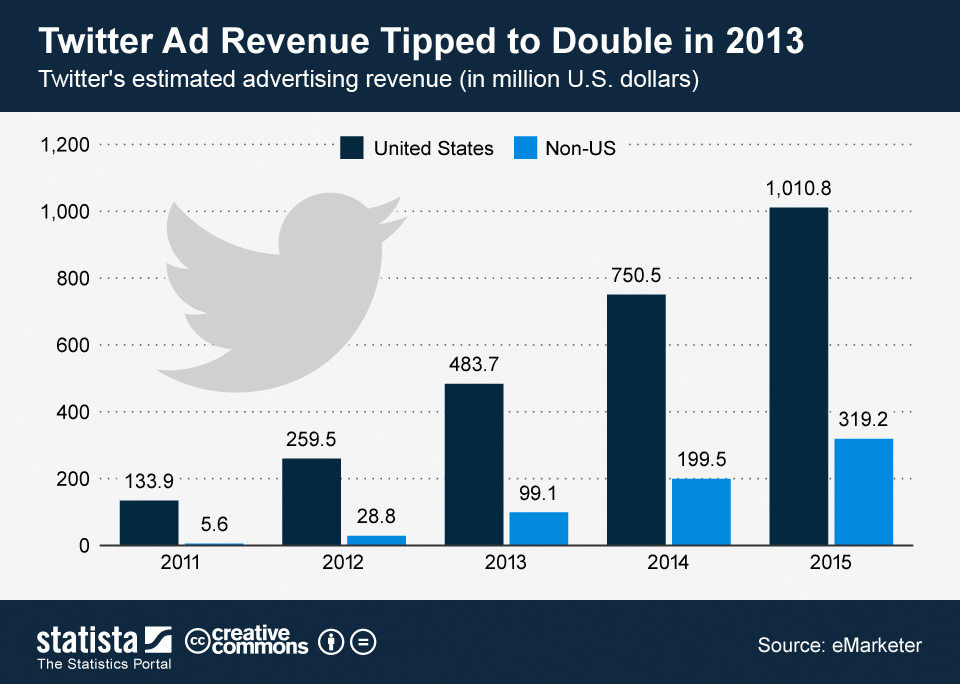
Twitter is set to grow it's income

Twitter is making some good progress. Much of this is coming from the mobile ad world.

Twitter Ad Revenue

Friday, March 22, 2013

Can you eliminate the need for email?

With some careful application of social media tools, could you actually eliminate the need for email?

Luis Suarez, who works for IBM, ditched email. He still has an email account, but since 2008 he’s tried to wean himself off email.

Suarez documents the decreasing amounts of email he receives with blog posts tagged “A World Without Email“. When he started, Suarez received more than 30 emails per day; by 2011 he received 16 emails per week. (I always imagine the phrase being read with the deep voice of movie trailer narrators, “In a world without email, one man stands alone…”)

Headlines highlight Suarez’s lack of email as an oddity. In 2012, Wired ran a story titled “IBM Gives Birth to Amazing E-mail-less Man“. The idea that a tech professional could do actual work without email boggles! Bah. Nearly impossible!

Headlines about Suarez should read “Man Chooses to Work in Public”. Suarez replaced email with a mix of internal and external social networking tools. He posts to his Wordpress-powered blog at elsua.net several times a month. He uses Twitter and Tumblr to share what he’s doing. He even uses Google+ now and then.

Suarez’s choice to share his work came as a result of thinking and practice. He worked for years in the field of Knowledge Management. And he’s highly proficient at learning new tools and ways of working: he started blogging back in 2005.

So, can you eliminate email? Yes, with the careful use of social media and the willingness to "work in public", it can be done. What is the value? Knowledge is shared. Work is collaborative.

Friday, November 16, 2012

Is it too early to think about 2013? Some questions for personal strategic planning

I know it may seem early but 2012 is winding down. Resolutions may not be the most useful exercise to go through. At least thinking through some really good questions might bring some focus to 2013.

It may not be all about planning but it could be about a better focus. Some of that could be thinks to stop doing. Here are some great questions to begin thinking about for 2013 via 4 Questions to get 2013 off to a roaring start | Escape From Cubicle Nation.
To do this exercise, I suggest getting nice and comfortable, and grabbing a paper and pen. Answer these questions:

1. I am at my very best when …

What conditions bring out your very best work? What kind of work are you doing when you are kicking major bootie? What people bring out your best work? Without overthinking it too much, brainstorm the factors that bring out your best work.

From this list, circle one thing that you will AMPLIFY in 2013.

2. These things drove me crazy in 2012 …

Have you been spinning around with the same annoying patterns in your head? Do you have any people in your life that make you nuts? Are you sick and tired of feeling sick and tired?

Brainstorm the things that have really made you batty this year.

From this list, circle one thing that you will ELIMINATE in 2013

3. I really want to make/do this in 2013 …

Is there an experience you are dying to have next year? Do you want to run your first marathon, write your first book, have your first baby or make your first product? Brainstorm the things or experiences that you would love to accomplish next year.

From this list, circle one thing that you will CREATE in 2013

4. Even during tough times this year, I appreciated …

Even the most optimistic life coaches have really crappy days. Life can be hard sometimes. If you had a whopper of a year, what are some things that you appreciated as the proverbial doo doo was hitting the fan? Brainstorm the big and small things that kept you grounded in 2012.

From this list, circle one thing that you want to APPRECIATE in 2013


Saturday, November 10, 2012

Do you need a multi-channel messaging strategy?

This is a very good blog on how disruptive social media has become for a business focus on the Customer. If you haven’t been convinced yet, this blog is for you.  The world has changed. Consumers have changed. We have to change to meet the needs and expectations of our customers. Are you ready?

Illustration of Facebook mobile interface
Social media and smartphones are disrupting the established patterns and practices for B2C interactions. To be successful, businesses have to engage with customers through their preferred channels, whether that be mobile, IM or social networks.

The link between technology and consumers is, however, a two-way street. Take, for example, Facebook notifications (the auto-generated email or text alerts you get when someone posts you on your wall or comments on a photo). These alerts constitute B2C dialogue, though they operate under the guise of a C2C interaction.

The initial attraction of social networks like Facebook and other pioneers in the space was bringing groups of people of shared interest together on the web. Adding a messaging capability to the basic web presence extends the social experience beyond the website. Without notifications, you’d have to go online to Facebook to hangout with your friends. With notifications, your friends — and the Facebook brand — come and check in with you throughout the day via your inbox.

This kind of messaging lets businesses participate in, inform, and add value to the social interaction (wall post/sharing) without ever forcing users back to the site.

Why Businesses Must Adopt a Multi-Channel Messaging Strategy


Wednesday, November 7, 2012

Social media and Presidential elections

Obama’s initial reaction to the news of his re-election was a three word tweet: "Four more years." alongside a picture of him and his wife Michelle in warm embrace. The message was retweeted more than 600,000 times, making it the most popular tweet in the history of the microblogging service.

The 31 million election-related tweets posted throughout yesterday, make Election Day 2012 the most tweeted political event ever.

With 327,452 tweets per minute, the activity peaked shortly after the first networks had called Obama’s re-election.


http://www.statista.com/topics/893/2012-election/

Sunday, November 4, 2012

Social Media Update: 11/4/2012

6 Habits of Highly Successful People Using Social Media for Sales - Social media has revolutionized how companies handle sales responsibilities. The traditional approaches to reaching out to new customers have been upended in many ways as business communication becomes increasingly social, with sales teams and social media managers working together in a unit to drive customer adoption.

This Week in Social Media Law: Do Cyberbullies Have First Amendment Rights? - A regular roundup of interesting issues at the intersection of social media and the law, as written by some of the nation’s leading lawyers. Cyberbullies claim First Amendment rights to freedom of speech (and lose). Company learns that the best defense against CAN-SPAM Act violations is a good contract. California Attorney General raises the bar for company privacy policies (for all of us).

Top 10 Reasons You’re Not Blogging - Addressed to all the naysayers who have not yet put fingers to keyboard and started blogging, here are the author's top 10 reasons why he thinks you "have not yet embraced the manifold benefits of blogging..."

Is Your Content Marketing Keeping Pace with Your Buyers? - If buyer’s abilities to master content are doubling every year, is your ability to inform growing at the same rate? This is profound. Buyers exposed to static content for two years straight are bound to lose interest. Fast.

How to Effectively Listen on the Social Web [Infographic] - An easy two-step guide on monitoring and acting on social media conversations to uncover deeper meaning of social conversations.

3 Ways to Boost Your Brand Without Facebook - Now that we know Facebook is charging brands to reach their own cultivated fans bases, what's a brand to do? If you don't have a budget for Facebook, here are three ways you can boost your brand without it.

Why Most Corporate Culture Programs Fail - Tribes have cultures, organizations don’t — unless they are one tribe. Most organizations have many tribes — you may have a developer tribe, a sales tribe, multiple customer service tribes, a cost conscious tribe, an innovator tribe, a middle management tribe, or a tribe of Belgian-American wine drinkers. Having multiple tribes means that you have multiple cultures.

Link Building Strategies of Yosemite Sam Meet Google’s Disavow Tool - Much like the cartoon counterpart, Yosemite Sam the link builder lacks strategy and instead gallops into the far reaches of the internet in search of links. I picture the Yosemite Sam link building strategy is one with guns drawn, wildly shooting into the air while jumping up and down left to right yelling “Wahoo! LINKS! Gimmie‘dem links!” To Sam, a link is a link and he wants all of them. This was working for him until a penguin walked onto the set...

Thursday, November 1, 2012

Do you suffer from Social Media FOMO?

Fear is real and we don't know sometimes the grip it can have on us. I hadn't thought of this, fear of missing out, but it is real.
Do you know FOMO? That’s not some fancy latte — it’s Fear Of Missing Out, and something that’s become a recognized thing by many social media users these days.

You’re probably familiar with the concept, if not the name. Here’s an example: It’s been a long workweek and you really just want to spend Friday night at home watching a movie. But then that old familiar urge hits, and you can’t resist grabbing your smartphone for a jolty fix of quick-burst information. One friend’s Twitter post mentions an awesome concert. On Facebook, someone else put up photos of a raging house party.

Suddenly, your mellow evening feels entirely inadequate and you wonder what else you’re missing out on. You put the phone down, only to pick it up again and again because you can’t shake the feeling that you’re missing out on finding out just how much you’re missing out on. The vicious cycle continues.

via Do You Suffer From Social Media FOMO? [INFOGRAPHIC].


Monday, October 29, 2012

Where's the walls now to your office? Not so clear anymore ... is it?

Industrialization

Walls to offices during the Industrial Age intended to guard leaders from the daily onslaught of activity and requests. Today, leaders are bombarded with Facebook requests, Twitter feeds, texts, IM pings, SPAM, an eMail from their boss demanding the most recent numbers in a report, and another eM just below the eMail from the boss ... from a friend sending a stupid "forward" eMail with cats in it.

Where's the walls now to your office? Not so clear anymore ... is it?

via Saying Goodbye to the Industrial Age | MAGsays.

We have moved to an "open world". Whether we want to believe it or not, the command and control world is now gone. It seems to me we have a choice. We can continue to ignore it. Where will that lead me? Or, we can embrace it. What would that look like?

Tuesday, October 23, 2012

How did being on-line change things for you so far this year?

oh, da's leuk :)

We are all online now more than ever. So how did being online change things for you this year?

Here are some questions to help get the answers:

  1. What business opportunities have you discovered through social media or other online channels this year?

  2. What online tool did you start using this year that changed the way you work?

  3. What online project helped you develop new knowledge or skills this year?

  4. What is the most important business or personal relationship that began or grew online this year?

  5. Which of 2012's entertaining online discoveries have helped you bond with friends, family or colleagues?


I would love it if you would share your thoughts on any of these questions. What do you think?