Showing posts with label Google. Show all posts

Sunday, November 17, 2013

Just the facts ~~ Please!!

Dragnet's Sgt. Joe Friday character frequently implore informants to provide 'Just the facts'. We have all kinds of "facts", data from analytic platforms and internal operational systems. Take the call center or a website. There is so much there that can help improve digital experiences dramatically because it separates fact from fiction.

To mine this data for experience improvement opportunities, focus our efforts in examining the actual behavior of customers. Many companies use Google analytics on their website. It helps us understand where visitors are going and what they do when they get there. Nothing like the facts. One company I know of used web analytics to prove a 65% customer drop-off rate at a point where login was required, prior to checkout. And when analysts at InterContinental Hotels Group (IHG) mined web analytics data for design opportunities, they found users pogo-sticking between search results and hotel landing pages, which tipped them off to the fact that users were digging for specific information.

Here are some other things to look for:
  • Study customers' mobile and tablet behavior
  • Examine customer behavior across channels
  • Look at the moments that matter

This is powerful for improving the customer experience. We have the facts.

Sunday, April 7, 2013

Usage Of RSS Feeds

Google has announced that it will shut down Google Reader on July 1, 2013. In its announcement, Google states that it’s doing this because the usage of Google Reader has declined and it wants to concentrate on fewer products. There was a lot of buzz online about this decision, and some fanatical Google Reader fans put together a petition to keep the RSS reader alive. They garnered more than 50,000 signatures in just a few hours.

Image representing Google as depicted in Crunc...

Forrester’s Technographics® data gives an understanding of the usage of RSS feeds over time. Google is right about the decline. The data shows that it was always only a dedicated group who used RSS feeds at least weekly — about 7% of US online adults in 2008; this had declined to just over 4% last year, with about one in 10 US online adults using RSS feeds about monthly.

RIP Google Reader. I will miss you.

Monday, April 1, 2013

Is it productive to work at home or anywhere other than the office?

Certain subjects just naturally incite opinion wars. The big ones, like political preferences, or whether you’re Team A or Team B, are better left out of polite conversation. But when it comes to doing your job effectively, where do we draw the line? Should the nature of a person’s autonomy — or lack thereof — be at the whim of the boss, or the discernment of the employee?

The four corners of the Internet nearly came to blows recently when tech-world darling and Yahoo CEO Marissa Mayer boldly put a stop to employees working remotely. Needless to say, people are a little upset.

I'm definitely in the let them work at home camp. Here is a pretty good infographic on the state of things.

Working from home infographic

Saturday, November 10, 2012

Do you need a multi-channel messaging strategy?

This is a very good blog on how disruptive social media has become for a business focus on the Customer. If you haven’t been convinced yet, this blog is for you.  The world has changed. Consumers have changed. We have to change to meet the needs and expectations of our customers. Are you ready?

Illustration of Facebook mobile interface
Social media and smartphones are disrupting the established patterns and practices for B2C interactions. To be successful, businesses have to engage with customers through their preferred channels, whether that be mobile, IM or social networks.

The link between technology and consumers is, however, a two-way street. Take, for example, Facebook notifications (the auto-generated email or text alerts you get when someone posts you on your wall or comments on a photo). These alerts constitute B2C dialogue, though they operate under the guise of a C2C interaction.

The initial attraction of social networks like Facebook and other pioneers in the space was bringing groups of people of shared interest together on the web. Adding a messaging capability to the basic web presence extends the social experience beyond the website. Without notifications, you’d have to go online to Facebook to hangout with your friends. With notifications, your friends — and the Facebook brand — come and check in with you throughout the day via your inbox.

This kind of messaging lets businesses participate in, inform, and add value to the social interaction (wall post/sharing) without ever forcing users back to the site.

Why Businesses Must Adopt a Multi-Channel Messaging Strategy


Monday, November 5, 2012

Apple iPad market share is dropping as rivals are catching up

The global tablet market continues to grow. According to market research group IDC, Apple, Samsung and co. shipped 27.8 million tablets in the past quarter, almost reaching the record of 28.2 million from last year’s holiday quarter.

With the iPad Mini, the first Windows 8 tablets and the popular $199 tablets from Google and Amazon all lined up for holiday season, the fourth quarter is likely going to be a blowout quarter for tablet vendors.

This chart shows global tablet shipments since the second quarter of 2012, the quarter in which Apple released the first iPad.


http://www.statista.com/topics/841/tablets/chart/695/global-tablet-shipments-since-q2-2010/

Meanwhile Apple’s market share in the global tablet market begins to erode. In the third quarter, Apple accounted for 50 percent of global tablet shipments, down from 66 percent in the June quarter and a new low since the introduction of the first iPad in April 2010. The launch of Google’s $199 Nexus 7 tablet and Amazon’s refresh of its popular Kindle Fire have clearly hurt Apple and the upcoming holiday quarter will show whether the iPad Mini can help Apple to re-strengthen its position. Starting at $329, Apple’s lower-end tablet is priced significantly higher than the entry models of Google and Amazon, a strategy that hasn’t fared well with many consumers.

This second chart shows global tablet market share in the third quarter of 2012, based on unit shipments.


http://www.statista.com/topics/841/tablets/chart/696/global-tablet-market-share-in-q3-2012/

Sunday, November 4, 2012

Microsoft may be down but are they out?

The new mobile wars are about an ecosystem across devices.  Microsoft is obviously not in a great position. I have casually looked at Windows 8 devices the last few days. I am encouraged by what I see. That said, in my house we have 2 iPads, 3 iPhones and 2 Android phones. I will buy a Windows 8 device soon. Probably a laptop/tablet combo. Here are the contenders from a recent Forrester report.

Image representing iPad as depicted in CrunchBase


  • Amazon puts content — and commerce — first. Amazon's strongest asset is its ability to deliver a rich assortment of content seamlessly to its customers, who are very comfortable with buying from the big retailer on any device, not just those from Amazon. In addition, the company is a powerhouse in cloud computing and provides seamless access to purchased and personal content across any device. Yet Amazon's device offerings are limited, and its use of a modified variant of the Android platform requires a devoted effort to entice developers to create application versions tuned to that variant. While Amazon has global ambitions, its reach today is much more limited than its competitors; additionally, its method of working with mobile operators challenges its expansion rate.

  • Apple exerts by far the strongest loyalty gravitational pull. Apple's collective offerings are demonstrably attractive to its customers, anchored most firmly by its most popular product, the iPhone. Consider that, compared with the total US online population, iPhone owners are 156% more likely to own an iPad, 188% more likely to own a Mac, and 235% more likely to own both. Apple has succeeded in providing digital distribution for nearly every major owner of music, video, books, newspapers, and magazines; additionally, while some media companies have publicly complained about Apple's perceived stranglehold on the market, by and large Apple has helped those companies benefit from digital disruption. Apple customers have warmly embraced the company's personal cloud services — but these services still have gaps to fill versus, for example, Google Docs.

  • Google touches the greatest number of mobile customers, but its loyalty force is less strong. The company's Android software has skyrocketed to become the leading smartphone platform, but Android phone owners are not as strongly drawn to other Android devices as is the case for Apple. Online adults in the US who own an Android phone are twice as likely to own an Android tablet than the total US online population — but also 13% more likely to own an iPad.  Google's range of content partnerships has grown rapidly in the past year. However, its library still falls short of both Apple's and Amazon's, and some media companies have shown reluctance to embrace Google as a partner given past collisions such as that between YouTube and Viacom. The company's greatest strength is in its broad reach via cloud services and its Chrome browser, which is now available on the vast majority of connected devices.

  • Microsoft has the steepest mountain to climb. Microsoft has been singularly unsuccessful in translating its dominance in PCs to the mobile market, in fact suffering from a loss of smartphone market share since the introduction of its revamped Windows Phone 7 OS. The company has no presence so far in the vital tablet market and, as a result, has struggled to attract developers to its mobile platforms. While Microsoft has released a wide range of personal cloud services such as SkyDrive, it has not effectively communicated the value of those services to its customers. Microsoft's greatest strength in content and media resides on the Xbox, whose connections to other devices powered by the company's software is nearly invisible. With the release of Windows 8 and Windows Phone 8, Microsoft hopes to translate a common user experience into loyalty across multiple devices — a tall order given its competitors' positions.

  • Others face a daunting task in building from (almost) scratch. It's clear that many companies seek to establish a competitive ecosystem. RIM promises that its upcoming OS revamp, BlackBerry 10, and associated devices will revitalize the once-dominant smartphone maker. Samsung, the world leader in phone shipments, has invested in its own bada OS, has a range of content partnerships and its own media store, and has also hedged its bets by joining Intel's Tizen development effort. Companies like HP, with strong ties to the enterprise, recognize the importance of having a diverse mobile offering, including smartphones. But we consider it highly unlikely that any of these companies can craft and unite all of the requisite components and then lure customers who have already placed their significant investments. Therefore their hope lies in those customers whose assets remain on the table — and there are billions of them.


Saturday, November 3, 2012

R & D spending to perceived innovation. Is Apple the best?

For the third year in a row, Apple has been voted most innovative company in the world by R&D professionals. In the survey, conducted by Booz & Company, almost 80 percent of the respondents named Apple as one of the three most innovative companies in the world. Google is a distant second with 43 percent of the respondents naming the search engine provider in their top three. This result comes at a time when many are starting to wonder whether Apple has lost its magical innovative touch. Although the company recently updated its entire product range, people are missing revolutionary new features from the company that re-imagined the mobile phone with the iPhone.

What’s interesting is the fact that Apple has the lowest R&D intensity (the ratio of R&D investments to a company’s sales) of all companies in the top ten. In fiscal 2011, Apple spent 2.2 percent of sales ($2.4 billion) on research and development. Google and Microsoft, two of Apples main competitors, each invested more than 10 percent of sales in R&D. Overall there is surprisingly little correlation between R&D expenditure and perceived innovativeness. Only three of the top ten R&D spenders in 2011 made the list of most innovative companies as perceived by the industry experts.

This chart shows a ranking of the most innovative companies in the world, based on a survey among 700 high-level R&D professionals.


http://www.statista.com/markets/15/technology-telecommunication/chart/686/the-most-innovative-companies-in-the-world/

Sunday, October 28, 2012

Good bye my good friend iGoogle

Recently I noticed something on my home page which is iGoogle. I've used what seems like forever.

I see a note that they are going to take it down completely. Click on the link and here is what I see. I am in shock. Not sure why but it is an emotional reaction I guess. I've been loyal. I've introduced lots of people to the power of iGoogle over the years. So what is the payback for my loyalty to Google and their products?

Apparently it isn't worth much.
Related articles

Tuesday, October 23, 2012

Will Yahoo turn it around? Third quarter results are in

Image representing Marissa Mayer as depicted i...

Yesterday afternoon, Yahoo! held an earnings call announcing third quarter results. The results modestly beat analyst expectations, but gave little insight about where the company is heading.

Revenue appears to have stabilized but shows no signs of growth either. Net income was extra-ordinarily high last quarter due to Yahoo’s sale of half its stake in Chinese Internet company Alibaba. Operating income declined 14 percent year-over-year though, giving a better idea of the state of Yahoo’s business.

CEO Marissa Mayer announced that her company will increasingly focus on search and mobile in the future and sees Yahoo! in a good starting position for the shift to mobile platforms.


http://www.statista.com/markets/21/internet/chart/669/yahoo-s-business-in-numbers/

Monday, October 22, 2012

Will the iPad Mini release continue Apple's domination of the tablet market?

English: Apple iPad Event

Tomorrow Apple will hold an event in San Jose, CA to unveil a highly anticipated addition to its iPad line-up. The long-rumoured smaller iPad (reportedly called ‘iPad Mini’ or ‘iPad Air’) is expected to be priced to compete directly with Amazon’s Kindle Fire and Google’s Nexus 7 tablet, both priced at $199. Although it is considered unlikely that Apple will match that price point, analysts expect a starting price way below the $499 of the cheapest full-size iPad.

Apple’s competitors will likely be on the edge of their seats when Tim Cook and Co. announce details about the all but confirmed tablet. If Apple manages to offer a competitive product at a price close enough to $199, Google and Amazon will see the biggest selling point of their tablets disappear. This could reinforce Apple’s stranglehold on the tablet market just as its competitors were starting to see some light.


In the second quarter of 2012, Apple’s market share was 68 percent, i.e. Apple shipped more than twice as many tablets as all of its competitors combined. In the September quarter (the numbers are not out yet), Apple’s market share will likely come in a little lower, as Google’s Nexus 7 has reportedly had a successful start. It will be interesting to see how the tablet market develops over the next few quarters with another iPad, more Android tablets and the first Windows 8 tablets in the mix.


http://www.statista.com/topics/841/tablets/chart/530/global-tablet-shipments-from-q2-2010-to-q2-2012/


Thursday, October 4, 2012

Are you putting your career at risk by not building your social network?

This is powerful. Think 5 years from now. Not too hard to do in some cases. Or, think 2 or 3. Will you regret not moving faster? I'm thinking we will.

Let's move fast. Let's get with it.
Picture yourself as an Executive in 2017, struggling to make sense of how many of your peers failed to become social. Many of them pushed aside by their more savvy underlings who built up both internal and external social networks. Their large networks wield tremendous power, collective intelligence and the ability to influence both employees and customers. Many of the executives that didn’t adapt were caught in a type of ‘vocational innovator’s dilemma’; where they stubbornly refused to change despite the warning signs.

Welcome to the new world. It’s the same as the old – only faster, smarter and a bit more effective.

via SAP's CIO: You're Putting Your Executive Career at Risk if You're Not Social - Forbes.

Monday, October 1, 2012

How mobile friendly is your recruiting web site?

Here is an interesting trend to look at and get on top of. I must admit I hadn’t thought about it from a recruiting point of view. We live in a world that is increasingly mobile. We all need to think mobile first.iPhone & Intel Mobile Device Potential employees clearly are.
The study found that a healthy 19% of job seekers use their mobile devices for career-related purposes (and more than 50% of could imagine doing so), yet only 7% of employers have a mobile version of their career website and only 3% have a mobile job app.

Mobile Recruiting Is on the Rise


Friday, September 21, 2012

Mapplegate: A Brief Take On Apple Vs. Google Maps

The mobile world is very fickle. Apple consumers are throwing a fit because of the change in map providers. I must admit I was reluctant to download myself but jumped in anyway. Others don't seem too inclined. On our internal Yammer feed there was a lot of chatter about what a good alternative was to the Apple offering. This was before the IOS was released.
Maps are strategic IP because they capture consumers' intent of where they want to go, which creates the opportunity to intervene and shape consumers' paths. Apple doesn't want Google to have that data on its users and doesn't want to give Google the opportunity to serve location-based guidance. The problem is that maps are difficult to build -- Nokia and Google (the two main map providers) have been building their map IP for years. Nokia maps, for example, are on nine of 10 in-car GPS systems, each of which acts as a probe that continuously improves Nokia's maps. Apple can't catch up overnight, and it seems as if Apple was premature in pulling the plug on Google Maps -- it has produced a consumer backlash, at least among early adopters.

via Mapplegate: A Brief Take On Apple Vs. Google Maps | Forrester Blogs.


Thursday, September 13, 2012

The Twitter or the hare?

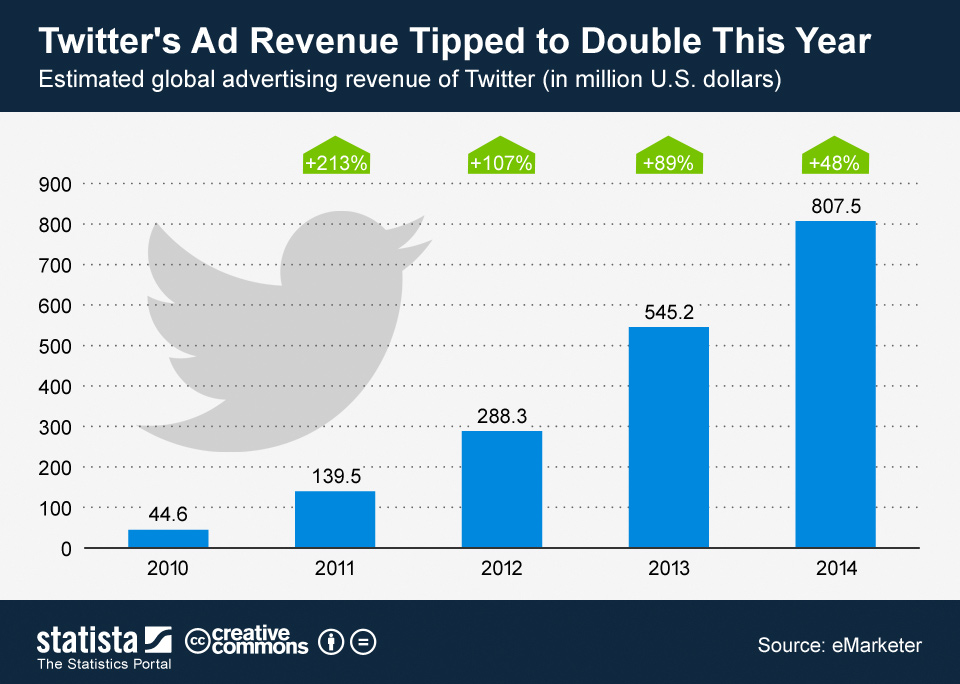
It seems like Twitter, a company once notoriously slow on monetization, has finally figured out a way to convert its growing user base into advertising dollars. Market research firm eMarketer expects Twitter’s advertising revenue to reach $288 million this year, a 107 percent increase over last year. Moreover, eMarketer predicts that the microblogging service could surpass $800 million in ad revenue in 2014.

This chart shows Twitter’s estimated advertising revenue from 2010 to 2014.


http://www.statista.com/markets/21/topic/194/social-media/chart/608/twitter-s-ad-revenue-tipped-to-double-this-year/