Showing posts with label United States. Show all posts

Sunday, August 11, 2013

How do you combine technologies to innovate?

This makes so much sense. It is the combination of technology that becomes so powerful in this model.

Well worth reading and thinking through as an enabler of innovation. Adam really nails this one.
These technologies can be combined in numerous ways, and we are just starting to see companies really taking advantage of the possibilities. These four technologies will have a disruptive impact on your business, almost regardless of which industry you're in. The question is whether you will choose to adopt them before a competitor does.

What are they?
1.  Microprocessors
2.  Sensors
3.  Wireless connectivity
4.  Databases

The Four Technologies You Need to Be Working With - Adam Richardson - Harvard Business Review

Monday, April 15, 2013

Hirable like me?

Most managers would like to think they base their hiring decisions on candidates’ skill. But new research suggests that once a candidate passes through an initial HR screening, a bigger factor comes into play: how similar the interviewee is to the person doing the hiring. Kellogg School of Business assistant professor Lauren Rivera spent nine months embedded in a professional service organization and noted three key reasons why this takes place: the "Will this person fit in?" question; the fact that people define merit on the basis of their own experiences; and that managers get excited by candidates who have similar passions and interests. Hiring managers forget that "there are other ways people can a) be likeable and b) be socially skilled other than being a mirror image," Rivera says.

More here: Hirable Like Me (Kellogg Insight)

Thursday, April 4, 2013

As a leader, do you have more than two modes of operating?

Any great leader faces a multitude of challenges every day. Whether it's communicating strategy, helping people through change, holding on to excellence in the face of compromise, or just navigating the leadership environment, there is no shortage of development opportunities lurking in each day's schedule.

Les McKeown has worked over the years with leaders on all of the challenges above--and many, many more. But surprisingly, the skill that he sees more leaders struggle with more than any other is relatively mundane (but very important): the ability to work with their team as an equal. To be "merely" a resource, rather than the team leader.

As we've seen, many leaders can only operate in one of two modes--in charge, or not there. In other words, once they join their team (virtually or otherwise), the team instantly defers to them, and they take the lead.

Truly great leaders have a third mode: The ability to sit with their team without needing to be in charge, using their subject matter knowledge just the same way as anyone else around the table would. More here.

Wednesday, April 3, 2013

Why are we going online?

Americans are going online to pass the time more than they were just a few years ago, according to a new study.

A report from Pew Research Center’s Internet & American Life Project found that about 53% of young adults ages 18 to 29 go online on any given day for no particular reason except for a diversion or just for fun. About 81% of people in this demographic said they have done so at least occasionally.

Friday, March 15, 2013

How to get ahead.I disagree.

This is a very disturbing article from Harvard Business Review. Here is one tidbit.
First, remember "A-B-D" — always be disagreeable:

People who are disagreeable earn more than people who are agreeable, and the gap is biggest among men, according to an analysis of four surveys spanning almost 20 years. Men who are significantly less agreeable than average earn 18.31% more than men who are significantly more agreeable than average, while the comparable figure for women is 5.47%, says the study, led by Beth A. Livingston of Cornell. Men's disagreeable behavior "conforms to expectations of 'masculine' behavior," the authors say.

via Ouch: A Year's Worth of Occasionally Disturbing Research on How to Get Ahead - Andrew O’Connell - Harvard Business Review.

From there, a long list of pretty disagreeable items continue. I kept looking for something redeeming. Nothing. Hmmm. If this is the list of what to do, I object.

Saturday, February 9, 2013

Are the number-cruncher days numbered?

OK, full disclosure. I have a Bachelor of Arts degree. Yes, I went the Liberal Arts route in college. This can be an asset when puzzling through complex or ambiguous situations; innovating; communicating; and understanding the customer through the power of “observation and psychology—the stuff of poets and novelists.” Yes, I also write poetry. :)

Do you have a Liberal Arts degree? Has it helped you in the business world?
Nobody is saying that numbers-crunchers’ days are numbered. But the idea that having people with a strong background in the humanities—what Peter Drucker termed “Management as a Liberal Art”—can provide companies with a great advantage is gaining some real momentum.

via Drucker’s Lost Art of Management | The Drucker Exchange.

Monday, December 24, 2012

Are we big enough to apologize for firing people because of our incomptence, not theirs?

When I read this I was stunned. It is the right thing to admit this, but I have never heard anyone say they fired people and it is because of their own incompetence.

I must confess. I am in the same boat here. Some of the people I've fired were incompetent. Some weren't and I was the problem. In a big organization, sometimes it doesn't seem to matter. To the people it happens to, it does matter.

So here is the challenge. Go back through the last few years. What percent falls into one group or another?

Then think through. What can I do to prevent that from happening next time?
As the year ends you think about your life, your accomplishments, your failures. In my case, as a tech entrepreneur I was thinking, not about the thousands of people I hired in my life through my companies and who did well and sometimes very well, but about the people I have had to fire. These people come in two distinct groups. The ones I had to fire because they were incompetent and the ones I had to fire because I was incompetent.

With the first group I am at ease. But this post is dedicated to the second group. The ones I had to fire because my start up didn't take off as planned. Like the first employees at Fon, we had to fire half of them only to hire others three years later. Like Fon took off, but later. It was hire, fire then hire again. Before at Jazztel the same thing happened: we hired too many, we then had to lay off hundreds and over time Jazztel has gone to an employee count that is at its highest ever. For both Fon and Jazztel, 2012 has been the best years of their existence but this is little consolation to the people I had to fire at the time. To those I owe an apology. My only excuse really is that the life of an entrepreneur is one of trial and error, and in my quest to build great companies I have to give things a try, and sometimes I am dead wrong. And people lose their jobs because of that. And they have families, mortgages, plans, and they suffer.

So here it is: this is an apology to all of those I had to fire in my life because I screwed up, because I failed, because I was incompetent. I am really sorry.

via An Apology | LinkedIn.

Tuesday, December 11, 2012

Are newspapers losing relevance as a news source?

Last week, mobile ad network Mojiva published the results of a survey regarding news consumption of smartphone and tablet owners in the United States. The results of the survey among 2,000 mobile device owners show that computers and television are the primary news source for most respondents. Meanwhile only one percent of smartphone and tablet owners consider newspapers their primary news source. Now that online sources deliver news 24/7, newspapers appear to have lost relevance as a news medium. To avoid obsolescence, newspaper publishers should embrace their new role and focus on in-depth analysis rather than news delivery.

 2012_12_10_News

http://www.statista.com/markets/14/topic/113/books-publishing/chart/765/primary-news-sources-of-american-tablet-and-smartphone-owners/

Monday, December 10, 2012

What trends should we avoid right now?

We all love to focus on the hot trends. We think that will lead us the promised land of disruptive technology.

[caption id="" align="alignright" width="220"]English: Disruptive Technology Graph English: Disruptive Technology Graph (Photo credit: Wikipedia)[/caption]

A good focus may be to avoid some of the "hot trends" and focus on so basics that increase our top line.

Here is a potential list to avoid:

Check out why in this thought provoking article via  5 Trends to Ignore in 2013 | Inc.com.

Monday, November 26, 2012

Guest Blog: Andrew Jackson (BravoTECH) - Candidates Have a Shelf Life

Today's guest blog is from Andrew Jackson. Andrew has spent the last 30 years building and managing technical service companies.   In 1996, he co-founded Bravo Technical Resources, Inc. (BravoTECH) an information technology professional services firm headquartered in Dallas. BravoTECH has experienced award winning growth with BravoTECH employees currently performing IT assignments across the United States. Andrew received a BSBA from Illinois State University and was recently inducted into the ISU School of Business Hall of Fame.

Andrew has been chairman of the board of the following organizations: Texas Association of Business Dallas and Ft Worth Chapters, the National Kidney Foundation of North Texas and the Dallas and Ft Worth Chapters of the National Multiple Sclerosis Society. He serves as a mentor on the Associate Board of the Cox School of Business at SMU, and has been a member of the Dallas Chapter of the Society for Information Management (SIM) since 2002. He Just completed his sixth term as SIM’s VP of Conferences and Seminars on the SIM International Management Council.

Candidates Have a Shelf Life

Do applicants for your technical positions have a shelf- life? You bet they do, and right now the shelf lives of top candidates are getting shorter as demand for skilled technical professionals is increasing. An unemployed or under-employed technology worker can find three to five viable career options in just a few days.

Many employers are finding that qualified candidates who had expressed an interest in their firm are gone by the time they finish their traditional, often slow-paced hiring processes.

BravoTECH has worked with hundreds of clients to help them expedite their hiring and onboarding processes in order to secure illusive A player candidates. Some areas that should be evaluated and can often be improved are:

  1. Number of interviews for a single position. Consider condensing the interview process by using group interviews. If numerous people are needed for a hiring decision, schedule multiple interviews on the same day.

  2. Background investigations. It's wise to perform a basic background check before making an offer, but unwise to delay a hiring decision while waiting days or weeks for results. An option is to make offers contingent on receiving positive background check results.

  3. Departmental inefficiencies. If other departments are involved in your screening and interviewing process, make sure they have the same sense of urgency as your team. Make sure they are aware of how soon you'd like the new position filled and how the new hire will contribute to helping your department meet its goals.

  4. Process and quality control. Believe it or not, some firms have totally automated or outsourced the applicant screening and selection process or they have empowered low level administrators to do the work. As a result, some very good applicants never make it to an interview. Make sure you know how your firm is screening and identifying potential candidates and if you do use an automated, external or non-technical person to screen applicants, allow for an exception policy so that candidates or services can protest an unreasonable deletion from the process.

  5. Drop unproductive, old school beliefs. One such belief is that you must interview three applicants for each position before making an offer. Instead, when you find a the right candidate, make a decision. Don't fall prey to analysis paralysis. By the time you look at the third applicant the first may be off the shelf!

Finally, remember that applicants are individuals who have expressed an interest in, not made a commitment to your firm. Their career options will grow the with the passage of time. Don't let processes keep you from hiring your share of the A Players who will likely not stay on the shelf for long.

Tuesday, November 20, 2012

Is your eCommerce mobile?

As we are approaching the most important days of this year’s holiday shopping season, many experts are predicting that mobile devices will play a bigger role than ever in the hunt for Christmas gifts.

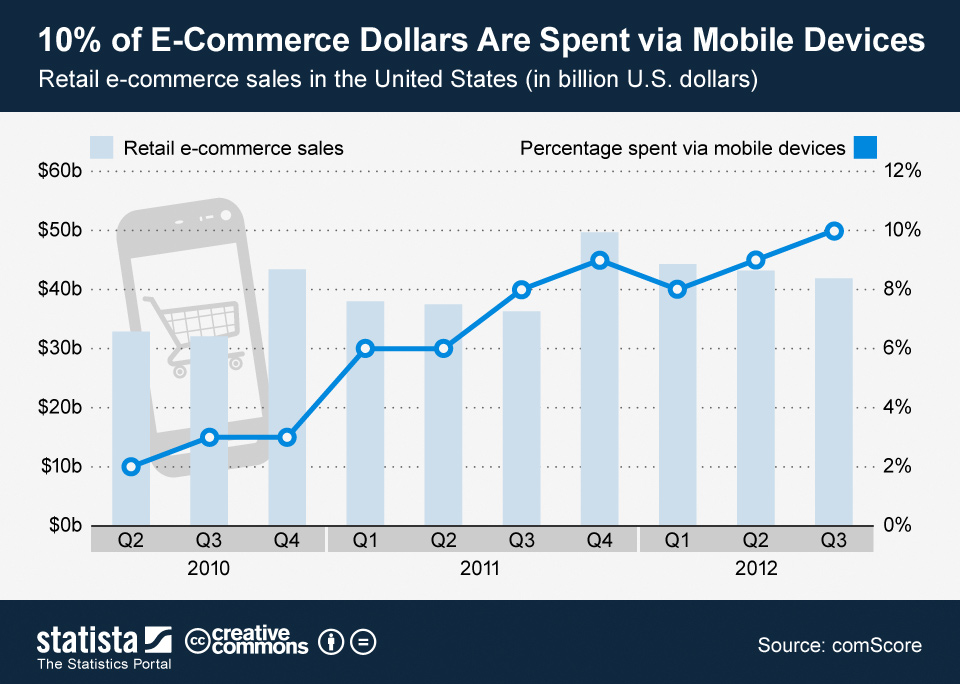
Consumers are using their smart devices to research products, check prices and more and more often to actually make a purchase. According to comScore data, 1 in 10 e-commerce dollars spent in the third quarter was spent via smartphone, tablet or another mobile device.

With ever-growing adoption of smartphones and the huge popularity of tablets, it can be safely assumed that the percentage of mobile purchases will grow further in the future and retailers are well-advised to embrace their mobile audience.

This  chart shows quarterly retail e-commerce sales in the United States and the percentage of sales made through mobile devices.


http://www.statista.com/topics/871/online-shopping/chart/726/e-commerce-sales-in-the-united-states/


Wednesday, November 7, 2012

Social media and Presidential elections

Obama’s initial reaction to the news of his re-election was a three word tweet: "Four more years." alongside a picture of him and his wife Michelle in warm embrace. The message was retweeted more than 600,000 times, making it the most popular tweet in the history of the microblogging service.

The 31 million election-related tweets posted throughout yesterday, make Election Day 2012 the most tweeted political event ever.

With 327,452 tweets per minute, the activity peaked shortly after the first networks had called Obama’s re-election.


http://www.statista.com/topics/893/2012-election/

Wednesday, October 31, 2012

Can things get worse for the U.S. print media?

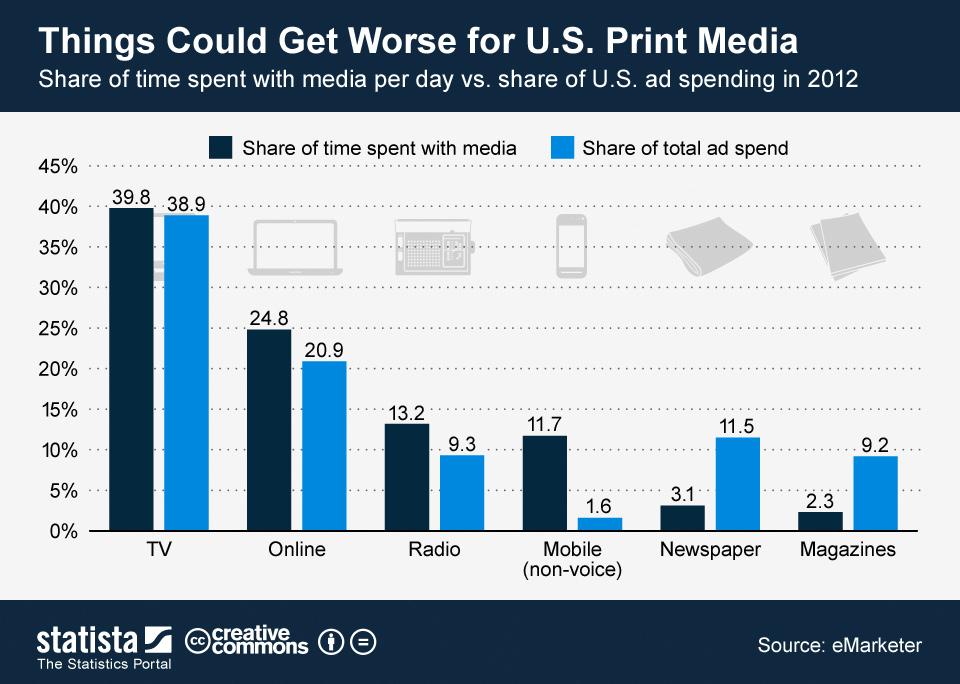
Can things get worse for the U.S. print media? Unfortunately, yes. Newspaper ad spending in the United States peaked in 2000 and has since then dropped to a level as low as it hasn’t been in 50 years. Magazines have suffered a similar fate and according to data released by eMarketer last week, the situation could get even worse for print media in the United States.

eMarketer compared selected media’s share of the time Americans spent with media with their share of total ad spend in 2012.

While in the cases of TV, online and radio, the time spent with the medium is roughly proportionate to the share of ad expenditure, newspapers and magazines hold a significantly larger share of total ad spend than they should if ad spend were proportional to the time spent with the medium.

American adults on average only spend 3.1 percent of their media time reading offline newspapers, yet newspapers rake in 11.5 percent of total media ad revenues.  The opposite holds true for mobile: Americans spend 11.7 percent of their media time on mobile devices, yet mobile advertising only accounts for 1.6 percent of total ad spend.

If the numbers at hand are any indication for the future growth of advertising mediums, mobile ad expenditure is about to take off. For newspapers and magazines however, the worst may be yet to come.


http://www.statista.com/topics/979/advertising-in-the-us/chart/682/share-of-media-time-vs-share-of-total-ad-spend/

Friday, October 19, 2012

Are Smartphones the new wallets?

eMarketer expects the transaction volume of mobile payments in the United States to reach $640 million this year and predicts a 100-fold increase until 2016. But are we really ready to ditch our wallets in favor of our smartphones?

When Apple released the iPhone 5 last month, some people were disappointed that Apple chose not to include a Near Field Communication chip for mobile payments. Others interpreted Apple’s omission of an NFC chip as proof that the time has yet to come for the technology to become relevant to the mass market. After all, Apple has a history of dismissing technologies until they have proven their viability. eMarketer expects 8 million Americans to make a point-of-sale purchase with their smartphone this year. That’s roughly seven percent of U.S. smartphone users and clearly shows that mobile payments are still in the early stages of adoption. If eMarketer is right, almost 50 million Americans will be using their phones to make in-store purchases by 2016. So the iPhone 7 will probably have NFC.


http://www.statista.com/topics/840/smartphones/chart/665/mobile-payment-forecast/

Thursday, October 11, 2012

What is the future of digital education?

Now this is radical thinking and it clearly has some big advantages and big disadvantages. My guess is that more and more of our world, including education, will move to be “virtual”, including the social aspects.

[caption id="" align="alignright" width="130"]Online education and Financial Aid Online education and Financial Aid (Photo credit: Wikipedia)[/caption]
In a radical rethinking of what it means to go to school, states and districts nationwide are launching online public schools that let students from kindergarten to 12th grade take some—or all—of their classes from their bedrooms, living rooms and kitchens. Other states and districts are bringing students into brick-and-mortar schools for instruction that is largely computer-based and self-directed.

Very balanced article from the WSJ. Online Education: My Teacher Is an App - WSJ.com


Friday, October 5, 2012

Online news surpasses newspapers and radio

You could see this coming but it is still amazing to know it has finally happened. I've noticed my own transition from a lover of newspapers to someone who has completely transitioned to completely consuming news online. Last week, the Pew Research Center published further evidence for the sorry state of the newspaper industry.

In the 2012 edition of Pew’s biennial survey on news consumption, only 29 percent of the respondents claimed having read a newspaper the day before, down from 58 percent in 1994 and 39 percent in 2002. Meanwhile, more and more Americans are turning to online sources to get their news updates. In 2012, 39 percent of the respondents had consumed online news the day before the survey, surpassing not only newspapers but also radio news. Television remains the number one news source for Americans. 55 percent of the respondents in the 2012 survey had watched a news program on TV on the day prior to the survey.

This chart shows how news consumption in the United States has changed over the past two decades. Will TV news be next?


http://www.statista.com/markets/14/media-advertising/chart/635/news-consumption-of-americans/

Friday, September 28, 2012

As a great leader, do you pay attention to politics?

Linda A. Hill and Kent Lineback, authors of "Being the Boss: The 3 Imperatives for Becoming a Great Leader," describe the three types of networks you need to succeed. Harvard Business Review video with Linda A. Hill, the Wallace Brett Donham Professor Business Administration at Harvard Business School and Kent Lineback who has spent many years as a manager and an executive in business and government.

A very honest conversation about politics in organizations and why it is important not to ignore it. You may be a CIO or a part of the C-Suite, a VP, a Director, a manager or team player. Should you ignore the politics of relationships?

http://www.youtube.com/watch?v=UGdRyPN3IRk&feature=g-vrec

Friday, September 21, 2012

Are you a hyperspecialist?

Tom Malone, professor at the MIT Sloan School of Management and author of the HBR article "The Age of Hyperspecialization," explains why breaking jobs into tiny pieces yields better, faster, cheaper work -- and greater flexibility for employees.

Is this a good thing or not? Are you taking advantage of it? What are the implications for managers?

http://www.youtube.com/watch?v=slK1RbPPGqY&feature=relmfu

Is it a technical problem? Or is it a human problem?

Eric Ries, entrepreneur-in-residence at Harvard Business School, explains how to find the human causes of technical problems. He suggest using the five why's to go beyond what seems like the root cause. He also suggests making incremental investments at all five levels that avoid all or nothing investments.

Very powerful.

http://www.youtube.com/watch?v=JmrAkHafwHI&feature=g-vrec

Monday, September 17, 2012

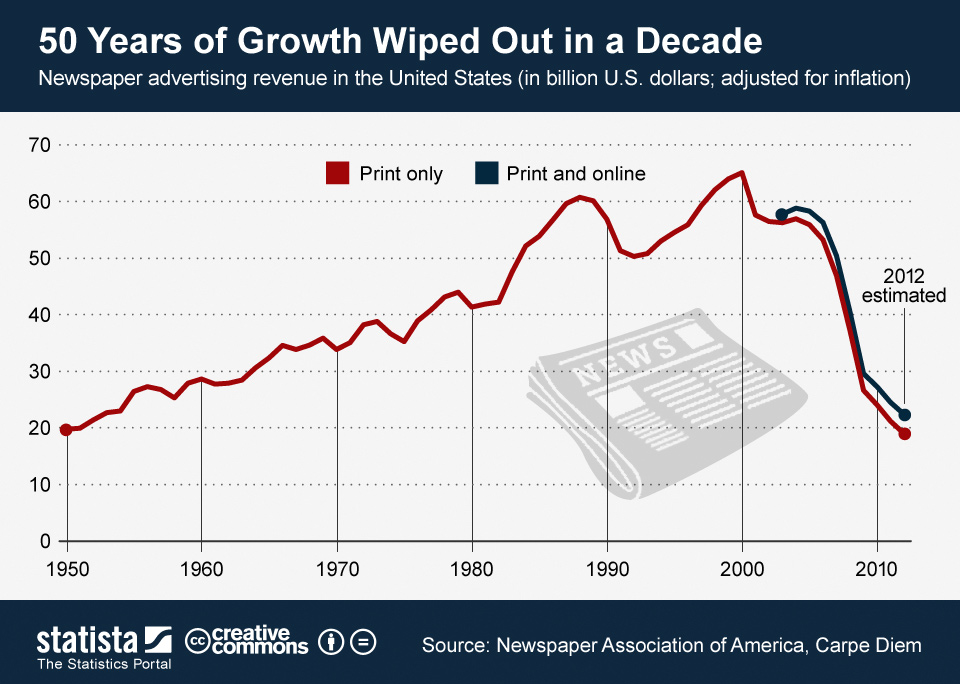
50 year view of newspaper advertising - This is not good for them

Two weeks ago, the Newspaper Association of America published its quarterly advertising report. The results were not good. In fact it was the worst quarter in thirty years when accounting for inflation.

Looking at annual numbers, the outlook is even more dramatic: if nothing extraordinary happens in the last few months of this year, 2012 will be the worst year for American newspapers since 1950. Professor Mark J. Perry of the University of Michigan estimates print advertising revenues of $19 billion this year. Taking inflation into account that is a 71 percent decline from the peak in 2000 and below the level of 1950!


http://www.statista.com/markets/14/topic/113/books-publishing/chart/612/newspaper-advertising-revenue-from-1950-to-2012/