Wednesday, December 12, 2012

Guest Blog: Jeb Dasteel (Oracle) - Are Customers Feeling the Love?

Are Customers Feeling the Love?


Guest Blog: Jeb Dasteel, Chief Customer Officer, Oracle


Oracle is not just the world’s largest business-software company; it’s also a disruptive force in hardware with its market-leading Engineered Systems. With more than 390,000 customers spread across 145 countries, Oracle has its hands full. The challenges and opportunities will only intensify as the company continues to introduce powerful new technologies across every one of its product lines, including Fusion, Oracle Cloud, Social Applications, x86 & SPARC Engineered Systems, Oracle Database 12c, and Oracle Solaris 11.Jeb Dasteel

In that context, success for Oracle means success for those customers by finding ways to infuse cutting-edge technologies into every facet of how the biggest organizations in the world operate, plan, and execute – and doing so smoothly and non-disruptively.

Against this broad landscape, I sat down recently with Oracle President Mark Hurd to talk about leadership, teamwork, and customer focus – all of which are becoming indispensable as the interplay between global businesses and their core technology partners becomes not only more strategic but more intimate.

 “We make a significant effort at Oracle to focus the organization on making customers successful in how they deploy Oracle technology and transform their business through IT,” said Hurd. “Technology is complex and our customers run complex businesses. So, fundamentally, our job is to simplify the technology and enable our customers to systematically improve their business operations and also go after real change that can transform how they compete.”

To achieve that objective, Hurd said, Oracle has to have more than just great technology—it also needs “to have the right mindset throughout the organization to truly partner with our customers.” On top of that, the company needs to have superb processes and discipline for engaging with and delivering value to customers, and Hurd said he believes Oracle has developed a unique approach to deliver just that.

“We’re very good at driving commercial transactions,” said Hurd. “Tens of thousands of them every year. Underlying that, we’ve got to have a very consistent way to build and manage relationships. And that’s not an abstract concept of relationships between organizations. I’m talking about people: a relationship between a CEO, CFO, CIO or other top executive and the Oracle team.”

Oracle breaks that process into three parts: listening to customers; responding to their needs, concerns, and business aspirations; and then collaborating with them on the adoption of leading technology that will help them be successful.

Hurd elaborated on each of those steps:

Listening: This includes transactional surveys on how well the company executes specific business processes and obligations; product surveys covering 15,000-plus products; relationship surveys that evaluate account management; dozens of advisory-board meetings each year; and a range of engagements with the nearly 1,000 Oracle user groups encompassing 500,000 members whose aim is to enhance the customer experience.

Responding: “We start with analytics – much like what we tell our customers to do,” Hurd said. “The analytics help us identify key customer feedback themes and then set priorities on how to address those themes.” These analytics include not only the normal customer satisfaction and loyalty measures, but also analysis of customer engagements and how they correlate with satisfaction and loyalty. Oracle extracts from those analyses 10 “customer feedback themes” that are refreshed every six months, with established programs to improve each.

“We also look at addressing individual customer issues very consistently and very fast. Our Support organization is the best in the world,” Hurd said. “We have reactive processes, knowledge bases and tools, and proactive mechanisms that anticipate issues before they even hit the customer.”

Collaborating for Customer Success: “This is really the core of our customer engagement model,” Hurd said. “It gives us the insight and means to manage relationships and truly partner with customers to mutual benefit.” As a result, Hurd and Oracle are able to apply a customer segmentation strategy that “determines exactly how we invest in the success of individual customers – across a very large number of accounts.”

In turn, that model allows Oracle to leverage many different account team resources: key account directors, team leaders, client advisors, and support account managers—all focused in unique ways and applying different sets of skills to help customers be successful. “We have a sophisticated account planning process that looks at the overall customer relationship across a rolling three-year time horizon,” Hurd said. “The account plan is a collaboratively developed approach to assuring the customer’s longer-term objectives are met at the same time that Oracle’s objectives are met.”

So are customers feeling the love? Yes, according to Kim Hammonds, CIO of The Boeing Company. “Oracle is focused on our relationship, but more importantly – they are focused on our business. Our job in IT at Boeing is to use technology to drive productivity, growth and value for our customers. Through their customer focus, Oracle has gained an understanding of our business, our challenges and our technology strategy so they are focused on our needs and our mutual success.”

Procter & Gamble is as well, according to Filippo Passerini, Procter & Gamble Group President of Global Business Services and CIO. According to Passerini, “In the past couple of years Oracle has step-changed their relationship with us. Traditionally focused on pure sales transactions, they are now bringing the right products, skills, and customer-focus to the table, with our success as the objective. It’s a true partnership.”

Tuesday, December 11, 2012

Are newspapers losing relevance as a news source?

Last week, mobile ad network Mojiva published the results of a survey regarding news consumption of smartphone and tablet owners in the United States. The results of the survey among 2,000 mobile device owners show that computers and television are the primary news source for most respondents. Meanwhile only one percent of smartphone and tablet owners consider newspapers their primary news source. Now that online sources deliver news 24/7, newspapers appear to have lost relevance as a news medium. To avoid obsolescence, newspaper publishers should embrace their new role and focus on in-depth analysis rather than news delivery.

 2012_12_10_News

http://www.statista.com/markets/14/topic/113/books-publishing/chart/765/primary-news-sources-of-american-tablet-and-smartphone-owners/

Monday, December 10, 2012

What trends should we avoid right now?

We all love to focus on the hot trends. We think that will lead us the promised land of disruptive technology.

[caption id="" align="alignright" width="220"]English: Disruptive Technology Graph English: Disruptive Technology Graph (Photo credit: Wikipedia)[/caption]

A good focus may be to avoid some of the "hot trends" and focus on so basics that increase our top line.

Here is a potential list to avoid:

Check out why in this thought provoking article via  5 Trends to Ignore in 2013 | Inc.com.

Friday, December 7, 2012

Don’t Make These Mistakes With Cloud CRM Solutions

There is a huge movement to cloud solutions for the world of CRM. Salesforce.com and Microsoft Dynamics can make easy and cost effective to implement solutions. There are still pitfalls to avoid. This is not your father’s CRM anymore, so don’t make these mistakes:

Customer Relationship Management
Trying to develop the “perfect” solution. Cloud CRM brings increased agility and flexibility, making it easier for organizations to tweak and upgrade the system after it is deployed. Unlike in the past, organizations don't have to deploy the perfect CRM solution all at once. Instead, they can deploy a “good-enough” system at first — as long as it is positioned so that the organization can quickly iterate and add improvements after deployment. One of the companies I talked with recommended, "Your organization should not focus on building the perfect solution, but rather on building a decent and sound solution that puts you in a position to quickly and easily improve it after deployment."

Spending too long on key decision points. Be prepared to make decisions quickly in order to drive development sprints, iterate quickly, and plan on the fly. But even though "agile" means that things get done faster, many organizations remain stuck in a traditional planning mentality. "To do agile well, you need to be able to make decisions very quickly and not spend too long on any one decision point." In order to achieve this, organizations must establish governance boards and project teams that represent interests from across the organization and have decision-making power to approve development plans and changes.

Not using information worker personas to guide development cycles. End user personas — similar to marketers' personas for consumer segmentation — are high-level overviews that illustrate how and why a typical user in a specific job role uses the CRM system and what benefits that user will receive from it. An implementation specialist at a professional services firm told me: "You need to consider how to make it easier for the end user to use the system. How can you make this system an improvement on their day-to-day life instead of a distraction?" Another advises: "Use stories to guide development sprints. Make sure that these stories represent the whole business for everyone who is going to touch the system."

Not having the right skill sets. Skilled business analysts (BAs) will become increasingly important as solution governance makes the shift from a focus on application installation to a business-centric process improvement. An IT leader at a financial information services company said: "We always need more BAs. This is a much more important skill set for working with SaaS solutions. We don't really need developers — that skill is less critical now.” BAs need to be skilled in business analysis, but also be trained in soft skills like facilitation, negotiation, communication, and collaboration.

via Don’t Make These Mistakes With Cloud CRM Solutions | CustomerThink.


Thursday, December 6, 2012

iPad eclipses iPhone launch

When Apple introduced the original iPad in January 2010, many analysts were sceptical whether the new device could replicate the iPhone’s success in establishing a new product category. Two and a half years and 100 million shipped iPads later, the answer has to be: yes!

Not only has the iPad redefined (or reignited) the tablet market, it even eclipsed the iPhone in terms of launch sales. In the first ten quarters after the iPad’s launch in April 2010, Apple shipped 98.16 million units of its popular tablet. During the same period after the iPhone’s launch in 2007, Apple shipped 33.75 million units of its popular smartphone. I.e. the iPad outsold the iPhone 3 to 1 in its first two and a half years on the market, making it one of the fastest consumer electronics launches ever. 

The recently launched iPad Mini could give iPad sales another boost, as the entry price to Apple’s tablet products dropped from $399 to $329.  This chart shows cumulative global unit shipments in the first 10 quarters after the launches of Apple's mobile gadgets: the iPod, the iPhone and the iPad.

Apple iPad growth

http://www.statista.com/topics/847/apple/chart/753/apple-s-mobile-product-launches/

Monday, December 3, 2012

Avoiding the big sucking sound of a time waster

We've all been there. Whether it is said explicitly or not, the clear message of the project is "I'll know it when I see it." When you hear or sense this you hear the big sucking sound of a time waster coming on. Invariable it creates an endless cycle of, "hmmmm not quite right." If the architectural drawings, high-heeled shoes or ad campaign doesn't meet their unstated standards, you're back to doing it again.

Sometimes you can make a handsome profit on all the fees you charge to redo things that indulge the ego of the customer, but more likely than not, your time is wasted until they're happy. If you have a client who feels the same way, you can work together to save time and money by being clear with each other about what's wanted. I think helping a client say what they want before they see it is a worthy endeavor.

Here are some good ideas from Seth Godin on how to avoid all this.


  1. Do it on purpose. When engaging with a new client, intentionally create an environment where personal taste is described in advance, and as much boundary-building as possible is done when it's cheap to iterate, not at the end when it's expensive.

  2. Demand benchmarks. The world is filled with things that are a lot like what you've been asked to create. So mutually identify them. Show me three other websites that feel like what you're hoping to feel like. Hand me a hardcover book that has type that reads the way you want yours to read. Walk me through a building that has the vibe you're looking for...

  3. Describe the assignment before you start. Using your words and the words of the client, precisely state what problem you're trying to solve. "We're trying to build something that does a, b and c, and not d..."

  4. Then, before you show off your proposal, before you hand in your work, restate the problem again. "You asked us to do a, b and c at a cost of under X. What I'm about to show you does a, it does b and it does c... and it costs half of X." This sort of intentional restatement of the scope of work respects your client by honoring their stated intent, at the same time it focuses your work on the stated goals.

  5. Make a decision about whether you want a reputation for doing this sort of focused work. If you do, don't work for clients who don't buy into the process. Over time, you'll earn the kind of clients you want.


via Seth's Blog: Avoiding "I'll know it when I see it".

Crossing the Innovation Chasm. Does CIO stand for Chief Innovation Officer?

Why does the Innovation Chasm exist? As a CIO, you have been charged with protecting your organization’s valuable assets, and with providing a reliable and stable infrastructure. As a result, you have become the “CI-No”:

  • “No, we can’t buy that application you saw in an airplane magazine.”

  • “No, we can’t have a new Web site built in two weeks.”

  • “No, we can’t do that because it will expose our customer data.”


You could be the CI-No because you were the only game in town: if the business wanted access to technology, they had to come through you. That’s not the case anymore. One of the byproducts of the perfect storm is that the business can now access technology directly from the Cloud without your involvement, and without your knowledge. It happens in companies of all sizes, in every industry, regardless of your IT or security stance. When business has access to that technology, it widens the chasm.

IT has to up its game, and smart CIOs are on a path to help the business use technology to innovate both what they do and how they do it.

Here is a great visual of how to align with the CEO.

CEO Hierarchy of Needs

via Crossing the Innovation Chasm.

Friday, November 30, 2012

Which mobile platform should you pick? Android, iOS, Windows 8 or HTML5?

The last month has introduced much new food for thought if you are trying to decide which mobile platform to build on first:

Thirty days ago, you were probably thinking to start with iOS, not just because of the launch of the iPad Mini but also the preponderance of Apps in iTunes

Then Microsoft launched Windows 8 (and the Surface), driving a full-court press to get developers to build apps for the Windows Store

A few days later, IDC came out with the latest numbers, showing Android was crushing everyone, with a 75% market share of new phones sold in Q3.

As a result, some declared that iOS was going the way of the Dodo–until last week, when iOS (especially the iPad) crushed the competition in online purposes purchases on Black Friday.

It has definitely been an eventful pre-Holiday Season in mobile.

With all these different metrics and shifts in leadership, which platform do you pick? The market share leader (Android)? The eCommerce leader (iOS)? The one most familiar to enterprise (Windows)? The one most open of all (HTML5)?

If you are Fortune-500 company with a big mobile budget the decision is easy: build on several. If you are smaller, you probably can only build one or two at most (or at least one to start on first). Which one do pick?

Question 1: What is the (Intended) Usage Pattern of Your Customers?


Question 2: If You ARE Building an App, What Are Your Customer Demographics?

Monday, November 26, 2012

Guest Blog: Andrew Jackson (BravoTECH) - Candidates Have a Shelf Life

Today's guest blog is from Andrew Jackson. Andrew has spent the last 30 years building and managing technical service companies.   In 1996, he co-founded Bravo Technical Resources, Inc. (BravoTECH) an information technology professional services firm headquartered in Dallas. BravoTECH has experienced award winning growth with BravoTECH employees currently performing IT assignments across the United States. Andrew received a BSBA from Illinois State University and was recently inducted into the ISU School of Business Hall of Fame.

Andrew has been chairman of the board of the following organizations: Texas Association of Business Dallas and Ft Worth Chapters, the National Kidney Foundation of North Texas and the Dallas and Ft Worth Chapters of the National Multiple Sclerosis Society. He serves as a mentor on the Associate Board of the Cox School of Business at SMU, and has been a member of the Dallas Chapter of the Society for Information Management (SIM) since 2002. He Just completed his sixth term as SIM’s VP of Conferences and Seminars on the SIM International Management Council.

Candidates Have a Shelf Life

Do applicants for your technical positions have a shelf- life? You bet they do, and right now the shelf lives of top candidates are getting shorter as demand for skilled technical professionals is increasing. An unemployed or under-employed technology worker can find three to five viable career options in just a few days.

Many employers are finding that qualified candidates who had expressed an interest in their firm are gone by the time they finish their traditional, often slow-paced hiring processes.

BravoTECH has worked with hundreds of clients to help them expedite their hiring and onboarding processes in order to secure illusive A player candidates. Some areas that should be evaluated and can often be improved are:

  1. Number of interviews for a single position. Consider condensing the interview process by using group interviews. If numerous people are needed for a hiring decision, schedule multiple interviews on the same day.

  2. Background investigations. It's wise to perform a basic background check before making an offer, but unwise to delay a hiring decision while waiting days or weeks for results. An option is to make offers contingent on receiving positive background check results.

  3. Departmental inefficiencies. If other departments are involved in your screening and interviewing process, make sure they have the same sense of urgency as your team. Make sure they are aware of how soon you'd like the new position filled and how the new hire will contribute to helping your department meet its goals.

  4. Process and quality control. Believe it or not, some firms have totally automated or outsourced the applicant screening and selection process or they have empowered low level administrators to do the work. As a result, some very good applicants never make it to an interview. Make sure you know how your firm is screening and identifying potential candidates and if you do use an automated, external or non-technical person to screen applicants, allow for an exception policy so that candidates or services can protest an unreasonable deletion from the process.

  5. Drop unproductive, old school beliefs. One such belief is that you must interview three applicants for each position before making an offer. Instead, when you find a the right candidate, make a decision. Don't fall prey to analysis paralysis. By the time you look at the third applicant the first may be off the shelf!

Finally, remember that applicants are individuals who have expressed an interest in, not made a commitment to your firm. Their career options will grow the with the passage of time. Don't let processes keep you from hiring your share of the A Players who will likely not stay on the shelf for long.

Wednesday, November 21, 2012

Are "A" players always promotable?

We've all been there. We have an amazing mid manager. They really get results. We promote them. They crash and burn. We all feel bad about it. How did we go wrong?

I am a big fan of Topgrading. Brad Smart is the guru. There is another way that prevents this scenario. Here are his latest thoughts.
Almost every leader I’ve interviewed has promoted people who were high performers in their current job, but failed when promoted. Years ago a popular business book was The Peter Principle (by Laurence J. Peter and Raymond Hull), a book that painfully documented how common it was to promote people to their level of incompetence. “She earned the promotion” made sense decades ago, and for years after The Peter Principle was released companies were more cautious -- people were NOT necessarily given promotions because they “deserved the chance.”

But in my recent experience, too many companies have fallen back into the Peter Principle trap and need a reminder.

Read more

Tuesday, November 20, 2012

Is your eCommerce mobile?

As we are approaching the most important days of this year’s holiday shopping season, many experts are predicting that mobile devices will play a bigger role than ever in the hunt for Christmas gifts.

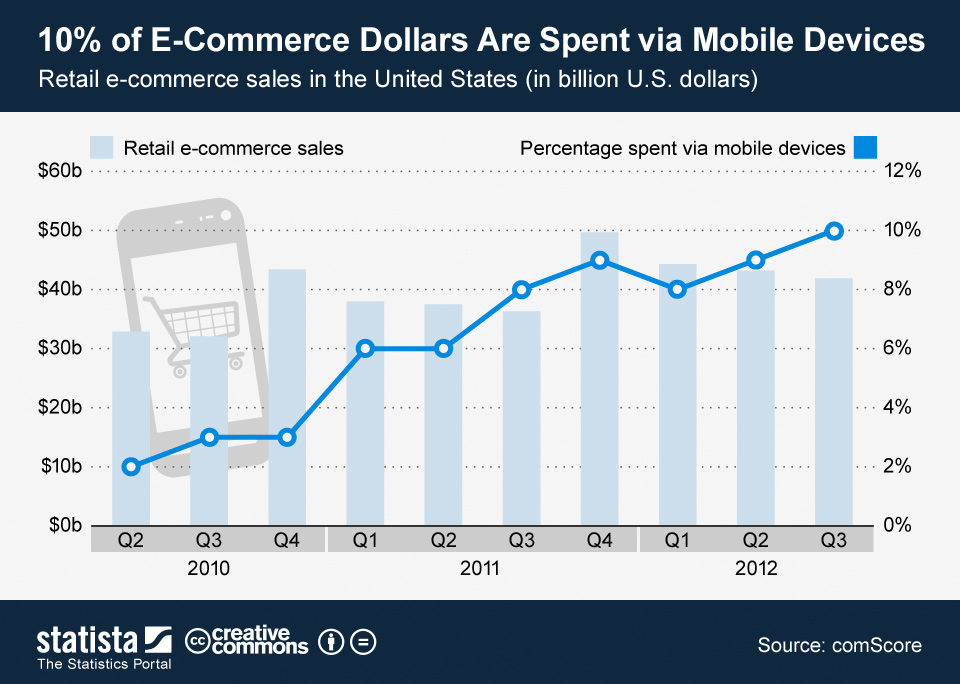
Consumers are using their smart devices to research products, check prices and more and more often to actually make a purchase. According to comScore data, 1 in 10 e-commerce dollars spent in the third quarter was spent via smartphone, tablet or another mobile device.

With ever-growing adoption of smartphones and the huge popularity of tablets, it can be safely assumed that the percentage of mobile purchases will grow further in the future and retailers are well-advised to embrace their mobile audience.

This  chart shows quarterly retail e-commerce sales in the United States and the percentage of sales made through mobile devices.


http://www.statista.com/topics/871/online-shopping/chart/726/e-commerce-sales-in-the-united-states/


Friday, November 16, 2012

Is it too early to think about 2013? Some questions for personal strategic planning

I know it may seem early but 2012 is winding down. Resolutions may not be the most useful exercise to go through. At least thinking through some really good questions might bring some focus to 2013.

It may not be all about planning but it could be about a better focus. Some of that could be thinks to stop doing. Here are some great questions to begin thinking about for 2013 via 4 Questions to get 2013 off to a roaring start | Escape From Cubicle Nation.
To do this exercise, I suggest getting nice and comfortable, and grabbing a paper and pen. Answer these questions:

1. I am at my very best when …

What conditions bring out your very best work? What kind of work are you doing when you are kicking major bootie? What people bring out your best work? Without overthinking it too much, brainstorm the factors that bring out your best work.

From this list, circle one thing that you will AMPLIFY in 2013.

2. These things drove me crazy in 2012 …

Have you been spinning around with the same annoying patterns in your head? Do you have any people in your life that make you nuts? Are you sick and tired of feeling sick and tired?

Brainstorm the things that have really made you batty this year.

From this list, circle one thing that you will ELIMINATE in 2013

3. I really want to make/do this in 2013 …

Is there an experience you are dying to have next year? Do you want to run your first marathon, write your first book, have your first baby or make your first product? Brainstorm the things or experiences that you would love to accomplish next year.

From this list, circle one thing that you will CREATE in 2013

4. Even during tough times this year, I appreciated …

Even the most optimistic life coaches have really crappy days. Life can be hard sometimes. If you had a whopper of a year, what are some things that you appreciated as the proverbial doo doo was hitting the fan? Brainstorm the big and small things that kept you grounded in 2012.

From this list, circle one thing that you want to APPRECIATE in 2013


Thursday, November 15, 2012

Do you have the right strategy?

Michael Jarrett, INSEAD professor, on the most important imperative for your business. Great 3 minute video. Much execution of strategy fails. We need to start with some core questions to succeed.

  1. Do we have the right strategy?

  2. Do we have a fair and open process to create the strategy?

  3. Do we use great project management skills to execute the strategy?

  4. Do we treat it as a real initiative to win buy in?


http://www.youtube.com/watch?v=nCo6WN_Q2GU&feature=g-user-u

Wednesday, November 14, 2012

Guest blog: Vinay Nadig - Have you checked on the health of your Operating System lately?

Vinay Nadig is my guest blogger today. Vinay's mission in life is to help people practice leadership as a daily behavior and enable themselves and their teams to achieve exceptional outcomes.

Vinay has spent more than 2 decades building companies, delivering value, serving clients, sometimes failing and ultimately succeeding on his own terms.  From a serial entrepreneur, to the leader of a business unit in a corporation, and entrepreneurial positions in technology startups, Vinay constantly “lives leadership daily.”   Vinay is usually engaged with a select group of client companies, doing meaningful work to help them grow the next generation of leaders.  On occasion, he works with motivated individuals who wish to take their performance to the next level and live exceptional lives.  He enjoys speaking at conferences and company events and discussing his opinions on his blog.

Vinay lives in the Dallas, TX area with his wife and two children. Here are his thoughts.

Have you checked on the health of your Operating System lately?


i.e. Your Core Operating System - the "software" that helps your leadership behavior.....

No, I don’t mean your version of Windows or Macintosh or Ubuntu.  I am listening to Daniel Pink’s Drive on audio, and he talks about the “operating system” for motivation (and the fact that it is outdated to fit today’s workplace).  It is fascinating and provoked me to apply it to the area of my particular passion – that of daily leadership behavior.

I believe that each of us has to design, build and polish our Cores – and the concept of Operating Systems (OS) fits right into this!  What kind of Core have we built? Do we think it is sufficiently refreshed to keep us relevant today?  Are there parts missing?  To wit:

  • Is your Operating System Open Source or Commerical? – {Are you in this for purely monetary rewards or a longer term sustainable objective? Listen, be honest – both models obviously work in the computer industry}.

  • Does your Operating System perform fast and reliably under peak loads? – {Do you have a Core set of competencies that you rely on to execute at exceptional levels, especially under pressure?}.

  • Does your Operating System support a large number of applications? – {Do you know how to enable, rather than direct and control?  Do you know how to play well with others?}.

  • Does your Operating System try to occupy a lot of space and features and try to gobble up single feature tools? – {Are you able to rely on your peers//teams//bosses and trust them to perform their roles as you perform yours?  Or do you have to do it all and always be at the forefront?}.

  • Can your Operating System be upgraded smoothly, with a minimum amount of loss to existing features and capabilities? – {Do you have the capacity to continue refreshing your Core, learning new skills, while retaining an unflagging Core?}.


So, take a few minutes and reflect on your Core.  You will be able to figure out that “upgrade path” as the technology mavens are always talking about – only this time it is your own internal “software”………

You can connect with Vinay:


Twitter:  @vinaynadig


Small Business Strategy: 10 Trends to Watch to stay on the disruptive edge

There is no doubt technology is disrupting the traditional business models. Customers are in charge and they are plugged in. No one of these may be right for you but you should be spending time researching which are the right ones and leveraging them. You can either disrupt or be disrupted.


Image representing Brian Solis as depicted in ...


So here is a good list to start with via Small Business Strategy: 10 Trends to Watch - Brian Solis..

 
1. Social Networks from Facebook to Twitter to Google+ and how they’re connecting to influencers and businesses (note: pay attention to nicheworks as well such as Path and Instagram.)

2. Geolocation check-in services such as Foursquare and Facebook location updates to share locations and earn rewards or opportunities for discounts

3. Crowdsourced discounts and deals including Groupon and LivingSocial and what’s valued and why

4. Social commerce services like Shopkick and Armadealo and how they create personalized experiences that are worth sharing

5. Referral based solutions like Yelp, Service Magic (now HomeAdvisor), and Angie’s List to make informed decisions and how shared experiences can improve your business, products, and services

6. Gamification platforms such as Badgeville and Fangager, and why rewarding engagement improves commerce and loyalty

7. How your consumers using mobile devices today and what apps they’re installing. Also, how they’re comparing options, reviewing experiences and making decisions while mobile?

8. The online presence your business produces across a variety of platforms such as tablets, smartphones, laptops and desktops. You must realize how consumers are experiencing the online presences you create and whether or not they deliver a holistic and optimized experience for each platform.

9. The consumer clickpath based on the platform consumers are using. Are you steering experiences based on the expectations of your customers? And are you taking into consideration the device or network where the clickpath begins and ends? Are you integrating Facebook F-commerce and m-commerce into the journey?

10. The expectations of connected consumers, what they value in each channel and platform, where they engage and how your business can improve experiences and make them worthy of sharing.


Monday, November 12, 2012

Leadership Lesson: Compassion and Courage

Compassion is a huge thing as a leader. It is lacking in so many cases today it is stunning. We hear a lot about freedom to make mistakes but what is the response if someone makes one, admits it and learns from it? As a leader, what is your response? Think about it.

Compassion International

So, what is courage? Can you lead from the heart? Do you have courage to forgive?

Courage is about connecting to reality and suspending judgement. As a leader, courage is about love. That is our mission. That is how we serve others.
"Without courage, compassion falters. Without compassion, courage has no direction." ~ Eric Greitens


Sunday, November 11, 2012

Is your strategy as a non-profit one about tote bags?

Author Seth Godin at PDF 2007

As a non-profit CIO, former fund raiser and customer strategy professional, Seth Godin nails this one. Hhe personally did the opposite of this in his successful effort to help end malaria in Africa. Check out the blog to see the end of the story. Well worth the read.
1,500 pair of shoes were made based on the futuristic sneakers he wore in the original Back to the Future movie. So far, typical bids are around $4,000 a pair, and it’s certainly going to go up as the auction goes on. Figure they’ll raise $10,000,000, easily. Good for them.

The interesting lesson for me is that this fundraiser is 100% about the shoes. The charity is an asterisk. This is a branding and nostalgia exercise, with the opportunity for resale at a profit thrown in as a bonus. Tote bag marketing, without a doubt. The lesson for fundraisers everywhere is: if you have something like a celebrity shoe or a signed Chuck Close painting to sell, you should definitely go do that. The ends are fabulous, and there’s nothing wrong with the means to get there.

Tote bag marketing, books and sneakers


Saturday, November 10, 2012

Do you need a multi-channel messaging strategy?

This is a very good blog on how disruptive social media has become for a business focus on the Customer. If you haven’t been convinced yet, this blog is for you.  The world has changed. Consumers have changed. We have to change to meet the needs and expectations of our customers. Are you ready?

Illustration of Facebook mobile interface
Social media and smartphones are disrupting the established patterns and practices for B2C interactions. To be successful, businesses have to engage with customers through their preferred channels, whether that be mobile, IM or social networks.

The link between technology and consumers is, however, a two-way street. Take, for example, Facebook notifications (the auto-generated email or text alerts you get when someone posts you on your wall or comments on a photo). These alerts constitute B2C dialogue, though they operate under the guise of a C2C interaction.

The initial attraction of social networks like Facebook and other pioneers in the space was bringing groups of people of shared interest together on the web. Adding a messaging capability to the basic web presence extends the social experience beyond the website. Without notifications, you’d have to go online to Facebook to hangout with your friends. With notifications, your friends — and the Facebook brand — come and check in with you throughout the day via your inbox.

This kind of messaging lets businesses participate in, inform, and add value to the social interaction (wall post/sharing) without ever forcing users back to the site.

Why Businesses Must Adopt a Multi-Channel Messaging Strategy


Wednesday, November 7, 2012

Social media and Presidential elections

Obama’s initial reaction to the news of his re-election was a three word tweet: "Four more years." alongside a picture of him and his wife Michelle in warm embrace. The message was retweeted more than 600,000 times, making it the most popular tweet in the history of the microblogging service.

The 31 million election-related tweets posted throughout yesterday, make Election Day 2012 the most tweeted political event ever.

With 327,452 tweets per minute, the activity peaked shortly after the first networks had called Obama’s re-election.


http://www.statista.com/topics/893/2012-election/

Tablets are the fastest adopted device in history

English: The iPad on a table in the Apple case

The use and adoption of tablets is exploding. Some just use it to access email on the run, others are using to easily show presentations to clients and customers and some are just having fun.

Tablets are the fastest-adopted devices in history. If we mark the modern tablet era by Apple's 2010 iPad launch, then an astounding 84 million iPads and as many as 120 million tablets in total have flown off the shelves in just two years. Forrester's global workforce and decision-maker surveys and client conversations show just how fast tablets are being adopted. What is your take on all this? As an iWorker, how are you using tablets?


  • Three-quarters of a billion tablets will be in use by 2016. It took more than 20 years for the PC to reach an installed base of 750 million people. But tablets will surpass that mark in less than half the time. Global tablet sales will top 375 million in 2016 with about one-third of tablets acquired by businesses for employees. Back in 2007, we wrote that to reach the second billion users, the computer market would be driven by lower-cost hardware, useful applications, and easy access to the Internet from anywhere.Tablets fit that bill perfectly.

  • Some 81% of firms expect to support tablets for employees. IT decision-makers are getting tablet fever as 81% of firms report interest in using tablets. According to these IT decision-makers, tablets will come into the enterprise via several doors, including employees bringing their own: Our latest survey of global information workers shows that 12% use tablets, and 8% paid for it themselves. And more than half of the 1,004 firms we surveyed plan to increase their spending on mobile devices and apps by at least 10% next year.

  • Tablets will accelerate the rise of the anytime, anywhere information worker. Today, 15% of information workers use at least three connected devices for work, work from at least three different locations, and use at least seven apps for work. And 30% of information workers satisfy at least two of those three criteria. The rise of tablets will drive the number of anytime, anywhere information workers up. Tablets enable access from more locations and bring relevant and useful apps to make employees more productive.


via Forrester Research : Research : Mastering The Business Tablet Landscape.


Tuesday, November 6, 2012

As a leader, what should you stop doing today? Here is a good list

I am a big fan of list of things "to stop" doing. We all have "to do" lists but we all need more "to stop" lists. Here is a good one for leaders.

Which is your favorite?
1. Out: Micro-management, or the need to control every aspect of your company. In: Empowerment, the ability to give your people some rope--even rope to make mistakes without blame.

2. Out: Management by walking around the office; it is no longer enough to be visible. In: Leadership by watching and listening, engaging in conversation, implementing the ideas presented to you, and distributing the results.

3. Out: Pretending you know everything. You don't have all the answers, so why try to make people think you do? In: Knowing your leadership team members and trusting them. Choose great people who have the right skills and fit the culture. And get out of the way.

4. Out: No mistakes, or a "no tolerance policy" some still think works. In: Learning from mistakes, or being the first to admit an error.

5. Out: The balance sheet drives the business, and informs all other decisions. In: People drive the business, boosting customer loyalty, and profit.

6. Out: Job competency is sufficient. Do the job asked, and you'll survive. In: Recruit "A" players who will go the extra mile. They're out there.

7. Out: Invest in technology to increase productivity. In: Invest in people.

8. Out: Demand change; be very specific about what you want and when. In: Nurture change; your people can come up with the best ideas and you can give them credit for it.

9. Out: Fried food in the cafeteria. In: Wellness in the workplace.

10. Out: Incentives; pay employees more money and they'll do more. In: Rewards; being valued matters more than money.

via Leadership Practices to Stop Today | Inc.com.


Monday, November 5, 2012

Apple iPad market share is dropping as rivals are catching up

The global tablet market continues to grow. According to market research group IDC, Apple, Samsung and co. shipped 27.8 million tablets in the past quarter, almost reaching the record of 28.2 million from last year’s holiday quarter.

With the iPad Mini, the first Windows 8 tablets and the popular $199 tablets from Google and Amazon all lined up for holiday season, the fourth quarter is likely going to be a blowout quarter for tablet vendors.

This chart shows global tablet shipments since the second quarter of 2012, the quarter in which Apple released the first iPad.


http://www.statista.com/topics/841/tablets/chart/695/global-tablet-shipments-since-q2-2010/

Meanwhile Apple’s market share in the global tablet market begins to erode. In the third quarter, Apple accounted for 50 percent of global tablet shipments, down from 66 percent in the June quarter and a new low since the introduction of the first iPad in April 2010. The launch of Google’s $199 Nexus 7 tablet and Amazon’s refresh of its popular Kindle Fire have clearly hurt Apple and the upcoming holiday quarter will show whether the iPad Mini can help Apple to re-strengthen its position. Starting at $329, Apple’s lower-end tablet is priced significantly higher than the entry models of Google and Amazon, a strategy that hasn’t fared well with many consumers.

This second chart shows global tablet market share in the third quarter of 2012, based on unit shipments.


http://www.statista.com/topics/841/tablets/chart/696/global-tablet-market-share-in-q3-2012/

Sunday, November 4, 2012

Microsoft may be down but are they out?

The new mobile wars are about an ecosystem across devices.  Microsoft is obviously not in a great position. I have casually looked at Windows 8 devices the last few days. I am encouraged by what I see. That said, in my house we have 2 iPads, 3 iPhones and 2 Android phones. I will buy a Windows 8 device soon. Probably a laptop/tablet combo. Here are the contenders from a recent Forrester report.

Image representing iPad as depicted in CrunchBase


  • Amazon puts content — and commerce — first. Amazon's strongest asset is its ability to deliver a rich assortment of content seamlessly to its customers, who are very comfortable with buying from the big retailer on any device, not just those from Amazon. In addition, the company is a powerhouse in cloud computing and provides seamless access to purchased and personal content across any device. Yet Amazon's device offerings are limited, and its use of a modified variant of the Android platform requires a devoted effort to entice developers to create application versions tuned to that variant. While Amazon has global ambitions, its reach today is much more limited than its competitors; additionally, its method of working with mobile operators challenges its expansion rate.

  • Apple exerts by far the strongest loyalty gravitational pull. Apple's collective offerings are demonstrably attractive to its customers, anchored most firmly by its most popular product, the iPhone. Consider that, compared with the total US online population, iPhone owners are 156% more likely to own an iPad, 188% more likely to own a Mac, and 235% more likely to own both. Apple has succeeded in providing digital distribution for nearly every major owner of music, video, books, newspapers, and magazines; additionally, while some media companies have publicly complained about Apple's perceived stranglehold on the market, by and large Apple has helped those companies benefit from digital disruption. Apple customers have warmly embraced the company's personal cloud services — but these services still have gaps to fill versus, for example, Google Docs.

  • Google touches the greatest number of mobile customers, but its loyalty force is less strong. The company's Android software has skyrocketed to become the leading smartphone platform, but Android phone owners are not as strongly drawn to other Android devices as is the case for Apple. Online adults in the US who own an Android phone are twice as likely to own an Android tablet than the total US online population — but also 13% more likely to own an iPad.  Google's range of content partnerships has grown rapidly in the past year. However, its library still falls short of both Apple's and Amazon's, and some media companies have shown reluctance to embrace Google as a partner given past collisions such as that between YouTube and Viacom. The company's greatest strength is in its broad reach via cloud services and its Chrome browser, which is now available on the vast majority of connected devices.

  • Microsoft has the steepest mountain to climb. Microsoft has been singularly unsuccessful in translating its dominance in PCs to the mobile market, in fact suffering from a loss of smartphone market share since the introduction of its revamped Windows Phone 7 OS. The company has no presence so far in the vital tablet market and, as a result, has struggled to attract developers to its mobile platforms. While Microsoft has released a wide range of personal cloud services such as SkyDrive, it has not effectively communicated the value of those services to its customers. Microsoft's greatest strength in content and media resides on the Xbox, whose connections to other devices powered by the company's software is nearly invisible. With the release of Windows 8 and Windows Phone 8, Microsoft hopes to translate a common user experience into loyalty across multiple devices — a tall order given its competitors' positions.

  • Others face a daunting task in building from (almost) scratch. It's clear that many companies seek to establish a competitive ecosystem. RIM promises that its upcoming OS revamp, BlackBerry 10, and associated devices will revitalize the once-dominant smartphone maker. Samsung, the world leader in phone shipments, has invested in its own bada OS, has a range of content partnerships and its own media store, and has also hedged its bets by joining Intel's Tizen development effort. Companies like HP, with strong ties to the enterprise, recognize the importance of having a diverse mobile offering, including smartphones. But we consider it highly unlikely that any of these companies can craft and unite all of the requisite components and then lure customers who have already placed their significant investments. Therefore their hope lies in those customers whose assets remain on the table — and there are billions of them.


Social Media Update: 11/4/2012

6 Habits of Highly Successful People Using Social Media for Sales - Social media has revolutionized how companies handle sales responsibilities. The traditional approaches to reaching out to new customers have been upended in many ways as business communication becomes increasingly social, with sales teams and social media managers working together in a unit to drive customer adoption.

This Week in Social Media Law: Do Cyberbullies Have First Amendment Rights? - A regular roundup of interesting issues at the intersection of social media and the law, as written by some of the nation’s leading lawyers. Cyberbullies claim First Amendment rights to freedom of speech (and lose). Company learns that the best defense against CAN-SPAM Act violations is a good contract. California Attorney General raises the bar for company privacy policies (for all of us).

Top 10 Reasons You’re Not Blogging - Addressed to all the naysayers who have not yet put fingers to keyboard and started blogging, here are the author's top 10 reasons why he thinks you "have not yet embraced the manifold benefits of blogging..."

Is Your Content Marketing Keeping Pace with Your Buyers? - If buyer’s abilities to master content are doubling every year, is your ability to inform growing at the same rate? This is profound. Buyers exposed to static content for two years straight are bound to lose interest. Fast.

How to Effectively Listen on the Social Web [Infographic] - An easy two-step guide on monitoring and acting on social media conversations to uncover deeper meaning of social conversations.

3 Ways to Boost Your Brand Without Facebook - Now that we know Facebook is charging brands to reach their own cultivated fans bases, what's a brand to do? If you don't have a budget for Facebook, here are three ways you can boost your brand without it.

Why Most Corporate Culture Programs Fail - Tribes have cultures, organizations don’t — unless they are one tribe. Most organizations have many tribes — you may have a developer tribe, a sales tribe, multiple customer service tribes, a cost conscious tribe, an innovator tribe, a middle management tribe, or a tribe of Belgian-American wine drinkers. Having multiple tribes means that you have multiple cultures.

Link Building Strategies of Yosemite Sam Meet Google’s Disavow Tool - Much like the cartoon counterpart, Yosemite Sam the link builder lacks strategy and instead gallops into the far reaches of the internet in search of links. I picture the Yosemite Sam link building strategy is one with guns drawn, wildly shooting into the air while jumping up and down left to right yelling “Wahoo! LINKS! Gimmie‘dem links!” To Sam, a link is a link and he wants all of them. This was working for him until a penguin walked onto the set...

Saturday, November 3, 2012

Customer Experience Update: 11/3/2012

Fidelity Communications Brings Customer Experience Into the Contact Center For smaller companies, superior service often becomes their ticket to success. For Fidelity Communications, a high-speed Internet, phone, and cable TV provider based in Missouri, transforming their contact center became the way to satisfy customers and engage call center agents across multiple states, thereby cutting costs, decreasing hold time, and building loyal relationships in an industry overshadowed by big business.

Hoffman's Hot Seat: Building the Contact Center of the Future 1to1 Media's Tom Hoffman catches up with Paul Jarman, CEO at inContact, about the trends that are shaping customer service, including rising customer expectations and the need for companies to become more agile and responsive in meeting the needs and preferences of their customers, and how these factors are influencing the requirements for running the contact center of the future.

6 Tips for Social Media Customer Service - Social media has revolutionized the way we communicate and is providing organizations a new way to interact with their customers and foster relationships. And customers themselves are leveraging social media to get the answers they need from the brands they do business with quicker and also magnify their voice. According to Jasdev Dhaliwal, head of communities for global social media and online engagement at AVG, 17 percent of Americans have used social media for their customer service needs at least once in the past year. "Customers have a voice and they're using it," Dhaliwal said during the Social Media for Customer Service Summit organized this week by Useful Social Media.

Your Customers Are Complaining. Do Something About It - I'm about to start a gut renovation of my kitchen, which, of course, is an incredibly stressful -- not to mention expensive - project. For cabinets, we got a recommendation for a designer at a local cabinet store. We met with her, got some great ideas, and went home to wait for the quote.

R & D spending to perceived innovation. Is Apple the best?

For the third year in a row, Apple has been voted most innovative company in the world by R&D professionals. In the survey, conducted by Booz & Company, almost 80 percent of the respondents named Apple as one of the three most innovative companies in the world. Google is a distant second with 43 percent of the respondents naming the search engine provider in their top three. This result comes at a time when many are starting to wonder whether Apple has lost its magical innovative touch. Although the company recently updated its entire product range, people are missing revolutionary new features from the company that re-imagined the mobile phone with the iPhone.

What’s interesting is the fact that Apple has the lowest R&D intensity (the ratio of R&D investments to a company’s sales) of all companies in the top ten. In fiscal 2011, Apple spent 2.2 percent of sales ($2.4 billion) on research and development. Google and Microsoft, two of Apples main competitors, each invested more than 10 percent of sales in R&D. Overall there is surprisingly little correlation between R&D expenditure and perceived innovativeness. Only three of the top ten R&D spenders in 2011 made the list of most innovative companies as perceived by the industry experts.

This chart shows a ranking of the most innovative companies in the world, based on a survey among 700 high-level R&D professionals.


http://www.statista.com/markets/15/technology-telecommunication/chart/686/the-most-innovative-companies-in-the-world/